What's inside
- Choose the Right Anchor Before Drilling
- Best Toggle Anchor Types for Heavy Mirrors
- Strap Toggles vs. Traditional Toggle Bolts
- Drilling and Installation Procedure
- Load Distribution and Common Failure Modes
- Which Toggle Anchor for Which Mirror Weight
- How to Pick the Right Toggle Anchor Size for a Heavy Mirror
- Common Questions About Heavy Mirrors and Toggle Anchors
- Also Consider: More Hardware for Heavy Mirror Jobs
- What to Buy
As an Amazon Associate I earn from qualifying purchases. This post may contain affiliate links at no extra cost to you.
A heavy mirror can pull surprisingly hard on drywall. The load is not only the mirror’s weight; it also includes the leverage created when the top edge stands slightly away from the wall. The right anchor depends on the mirror’s weight, hanging hardware, and whether you can hit a stud. For most large framed mirrors mounted to drywall, steel toggle anchors are the strongest practical choice when studs are unavailable.
As an Amazon Associate we earn from qualifying purchases at no extra cost to you.


Updated November 2026 – Short answer: the best toggle anchors for mounting a heavy mirror on drywall are strap-style toggles such as the TOGGLER SNAPTOGGLE 1/4-20 kit, backed by a French cleat or rail so the load spreads across at least four fasteners. Second choice is the TOGGLER Toggle TB, and the KURUI and Bemaka toggle-bolt kits are the budget route for mirrors that are not extreme in weight.
What we cover
- Choose the Right Anchor Before Drilling
- Best Toggle Anchor Types for Heavy Mirrors
- Strap Toggles vs. Traditional Toggle Bolts
- Drilling and Installation Procedure
- Load Distribution and Common Failure Modes
- Which Toggle Anchor for Which Mirror Weight
- How to Pick the Right Toggle Anchor Size for a Heavy Mirror
- Common Questions About Heavy Mirrors and Toggle Anchors
- Also Consider: More Hardware for Heavy Mirror Jobs
- What to Buy
Our Top Picks
 TOGGLER SNAPTOGGLE Drywall Anchors with 1/4-20 Bolts20 Pack w/ Round Head Bolts0.25 x 0.25 x 6.5 Inches1 PoundsCheck on Amazon
 KURUI Heavy Duty Hollow Drywall Anchors for Sheetrock1/8 3/16 1/46.1 x 5.1 x 0.73 InchesCheck on Amazon


Choose the Right Anchor Before Drilling
First, weigh the mirror if possible. Do not rely on a guessed weight from its size. A 36-by-60-inch framed mirror may weigh 35 to 60 pounds, while a similarly sized mirror with a thick wood or metal frame can be considerably heavier.
Next, inspect the hanging system. A pair of D-rings, a French cleat, or a continuous mounting rail spreads the load across two or more fasteners. A single picture wire attached to two side rings concentrates more force at the fasteners and can shift from side to side. For a heavy mirror, use the manufacturer’s rail or cleat whenever available.
If a stud is in the correct location, drive a structural wood screw directly into it. That is usually stronger and more dependable than any hollow-wall anchor. Use an electronic stud finder, confirm the location with a small drill bit, and avoid electrical wiring and plumbing. If the hardware locations do not line up with studs, use toggle anchors rather than small plastic expansion anchors.
Best Toggle Anchor Types for Heavy Mirrors
| Anchor type | Typical useful range | Best use | Main drawback |
|---|---|---|---|
| Spring-wing toggle bolt | About 50 to 100 pounds per anchor in suitable drywall | Maximum strength at low cost | The wings fall behind the wall and cannot be removed without losing them |
| Strap-style snap toggle | Often about 50 to 100 pounds per anchor, depending on size and wall condition | Heavy mirrors and rails that may need adjustment | Costs more and requires a larger hole |
| Self-drilling metal toggle | Roughly 25 to 60 pounds per anchor | Medium-heavy mirrors and quick installation | Usually less capacity than a large strap toggle |
| Plastic expansion anchor | Usually under 25 pounds in real-world drywall use | Light frames and small mirrors | Poor choice for a heavy, high-consequence load |
Ratings vary widely by brand, drywall thickness, installation angle, and whether the load is straight down or pulling outward. Treat package ratings as laboratory limits, not a promise. For a mirror, I prefer at least a 2:1 safety margin. A 60-pound mirror should not be supported by anchors whose combined claimed capacity is only 60 pounds.
For the strongest drywall-only installation, choose strap toggle anchors for drywall in a size compatible with your mirror hardware. Large 1/4-inch toggle bolts or strap toggles are generally better suited to heavy mirrors than 1/8-inch versions.
Strap Toggles vs. Traditional Toggle Bolts
Traditional spring-wing toggle bolts are inexpensive and strong. They need a hole large enough for the folded wings, commonly 1/2 inch or more. Once installed, the bolt can usually be removed, but the wing drops into the wall cavity. That makes repositioning inconvenient and leaves a loose metal part inside the wall.
Strap-style toggles use plastic straps to pull a metal channel against the back of the drywall. You push the channel through a drilled hole, slide a collar tight to the wall, snap off the excess strap, and drive the screw. The metal channel remains captured behind the wall, so the screw can be removed and reinstalled. That is useful if you need to level the mirror or remove it for painting.
A strap toggle is my usual recommendation for a mirror heavier than about 40 pounds, especially when the mirror hangs from a rail. A traditional toggle bolt is fine when the hardware fits it and access is tight. For a lighter mirror, a self-drilling metal toggle anchor can be faster, but do not confuse convenience with maximum holding power.
Drilling and Installation Procedure
Mark the fastener positions carefully using the actual mirror hardware as a template. Measure from the floor and from a nearby corner, then use a level. A mirror can be secure yet look crooked if the marks are off by only a few millimeters.
Use a sharp drill bit sized for the toggle anchor. A cordless drill on a low or medium clutch setting is enough; a hammer drill mode is unnecessary and can tear the paper face of the drywall. Drill cleanly without wobbling. An oversized hole reduces the anchor’s support area and can let the anchor spin.
Before drilling, check for wiring and plumbing. A stud finder with AC detection helps, but it is not foolproof. Do not drill deeply just to make a toggle hole. Stop if the bit meets unexpected resistance after passing through the drywall surface.
Install each toggle according to its instructions. The metal channel must lie flat against the back of the drywall, not sideways or diagonally. Tighten the screw until the hardware is firmly seated, but do not crush the drywall. Over-tightening can dimple the wall, enlarge the hole, and reduce holding power.
Load Distribution and Common Failure Modes
Use at least two anchors whenever the mirror hardware allows it. Four anchors are better for a wide rail because they reduce rotation and spread the load. Keep fasteners separated horizontally; placing two anchors almost on top of each other does little to resist tipping.
The most common failure is a torn-out drywall face caused by an anchor installed too close to an existing hole, damaged drywall, or a seam. Another is a mirror that slowly tilts because the lower edge is not restrained. If the frame has no lower mounting point, add suitable bumpers or a lower clip so the mirror cannot swing away from the wall.
Do not hang a very heavy mirror from drywall alone if the drywall is soft, water-damaged, cracked, or thinner than expected. In that situation, locate studs, open the wall to add blocking, or use a mounting rail that reaches multiple studs. For exceptionally heavy mirrors—roughly 100 pounds or more—professional installation and a stud-supported system are sensible.
Which Toggle Anchor for Which Mirror Weight
Package ratings describe a clean straight-down pull in half-inch drywall, so the table below applies the 2:1 margin from earlier. Weigh the mirror first, then pick the row. These are planning guidelines, not guarantees, and they assume sound, dry, half-inch drywall.
| Mirror weight | Hanging hardware | Anchor choice | Minimum fasteners |
|---|---|---|---|
| Under 25 lb | Two D-rings or wire | Self-drilling metal toggle, such as the ALBO kit | 2 |
| 25 to 50 lb | D-rings or a rail | 1/8- to 3/16-inch toggle bolts or small strap toggles | 2 to 4 |
| 50 to 80 lb | Rail or French cleat | 1/4-20 strap toggles | 4 |
| 80 to 100 lb | Cleat that reaches a stud | Strap toggles for the unsupported side, wood screw into the stud | 4 plus stud |
| Over 100 lb | Stud-supported cleat | Do not rely on drywall alone | Stud blocking |
How to Pick the Right Toggle Anchor Size for a Heavy Mirror
Size is the question most buyers get wrong. A toggle anchor is sized by the bolt that goes through it, and the bolt has to be large enough to carry the mirror hardware without bending. Follow these thresholds.
- Bolt diameter: use 1/4-inch hardware for mirrors above about 40 pounds. The 1/8-inch bolts in assortment kits are for frames and small mirrors.
- Hole size: strap toggles and larger toggle bolts need a bigger hole, often 1/2 inch or more. Check the maker’s hole-size chart before drilling, because an oversized hole cannot be corrected.
- Bolt length: the screw must pass through the mirror hardware, the drywall and the toggle channel with a few threads to spare. Half-inch drywall plus a rail rarely needs more than a short screw, but double-layer drywall does.
- Drywall thickness: most ratings assume 1/2-inch board. In 5/8-inch fire-rated board, check that the strap length covers the wall thickness.
- Spacing: keep anchors at least a few inches from each other, from seams and from corners so the drywall face is not torn out.
Common Questions About Heavy Mirrors and Toggle Anchors
How much weight can a toggle anchor hold in drywall?
A good strap toggle in half-inch drywall is typically rated well above 100 pounds per anchor under ideal conditions, while small toggle bolts are rated far lower. Real-world capacity is lower, so plan on a 2:1 margin and use at least four anchors for a heavy mirror.
Can I hang a heavy mirror on drywall without studs?
Yes, for mirrors up to roughly 80 to 100 pounds if you use strap toggles, a rail or French cleat, and at least four anchors. Above that weight, add blocking or hit studs.
Are toggle bolts or strap toggles better for mirrors?
Strap toggles are easier because the metal channel stays in place when you remove the screw, so you can level or remove the mirror. Traditional toggle bolts are cheaper and just as strong, but the wing falls into the wall when the bolt comes out.
Can I reuse a toggle anchor after moving the mirror?
Strap-style anchors can usually be reused if the channel and strap are intact and the hole is not enlarged. Spring-wing bolts lose their wing, so replace those.
Do I need a French cleat for a heavy mirror?
It is the best hanging method for a heavy mirror because it spreads the load along the whole wall bar and lets you slide the mirror sideways to level it. Fix the wall half with toggles or screws into studs.
Also Consider: More Hardware for Heavy Mirror Jobs
These products are not the top toggle picks, but each solves a specific part of the job. Their specs below come from the listing titles and the makers’ descriptions.
Hillman Toggle Bolts 3/8 in x 4 in – Best for Oversized Toggle Bolts

The Hillman 25-pack contains zinc-plated steel toggle bolts with a round slotted head. It suits an oversized mirror, a heavy mounting rail or a ceiling-hung item where a large spring-wing toggle is acceptable, and it saves money when you need many anchors. The large diameter means you will drill a correspondingly large hole, so measure the mirror hardware first.
- 3/8-inch x 4-inch toggle bolts
- 25 per pack
- Zinc-plated steel
- Round head with slotted drive
Pros: large-diameter bolt; low cost per anchor; strong in solid, dry board.
Cons: needs a big hole; the wing falls inside the wall if you back the bolt out; far more than a normal mirror needs.
Skip it if you want to remove and re-hang the mirror often.
E-Z Ancor Twist-N-Lock 75-lb Drywall Anchors – Best for Medium Mirrors
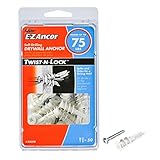
The E-Z Ancor Twist-N-Lock is a threaded self-drilling anchor sold in a 50-piece pack with #8 x 1-1/4-inch screws and a 75-pound rating. It is quick to install with a screwdriver and fits mirrors in the 20-to-40-pound range when you can use four anchors on a rail. It is not the choice for a very heavy mirror.
- #8 x 1-1/4-inch screws
- 75-pound maker rating per anchor
- 50 anchors per pack
- Installs without a pilot hole in standard drywall
Pros: fast installation; good value; leaves a small hole.
Cons: less holding power than a strap toggle; thread can strip if over-tightened; rated for standard drywall only.
Skip it if the mirror weighs more than about 40 pounds.
AENTGIU 30-Inch French Cleat – Best for Spreading a Heavy Mirror Load

This aluminum Z-clip French cleat is sold as two pairs, 30 inches long, with a built-in level and a 200-pound listed capacity. The wall bar spreads the load over several anchors, so it pairs well with 1/4-20 strap toggles. Attach one bar to the mirror and one to the wall, then lock them together.
- 30-inch aluminum Z-bar
- 2 pairs per set
- Maker lists 200-pound capacity (applies to a stud-supported install)
- Includes a bubble level
Pros: spreads weight; makes leveling easy; hides the hardware behind the frame.
Cons: adds frame thickness; the capacity depends on the fasteners behind it; frame must be sturdy enough to hold the bar.
Skip it if the frame back is too thin to fit a cleat.
Franklin Sensors ProSensor M150 – Best Stud Finder for Locating Backup Support

The ProSensor M150 is a 9-sensor stud finder with an AC wire warning. A stud behind the mirror is the best support you can have, so finding one saves a lot of risk. The wire alert helps before you drill any toggle hole, though you should still keep holes shallow.
- 9-sensor scanner
- AC wire warning
Pros: marks the whole stud width at once; wire warning; simple to use.
Cons: more expensive than basic units; not a substitute for checking behind the wall; results can vary in textured or plaster surfaces.
Skip it if you already have a magnet or a stud finder you trust.
What to Buy
For most heavy drywall-mounted mirrors, buy four appropriately rated 1/4-inch strap toggles, unless the mirror’s rail specifies different hardware. Add a level, a stud finder, a sharp drill bit, and a drill with a controllable clutch. If the mirror weighs less than about 30 pounds and has two mounting points, smaller metal toggles may be adequate. Cheap plastic anchors are acceptable for lightweight decorative mirrors, not for a large glass mirror above furniture or a walkway.
The best anchor is ultimately the one installed in sound material and used with hardware that spreads the load. A stud-supported screw remains the first choice; a properly installed strap toggle is the reliable fallback when the wall cavity is all you have.
FAQ
How much weight can a toggle anchor hold in drywall?
Can I hang a heavy mirror on drywall without studs?
Are toggle bolts or strap toggles better for mirrors?
Can I reuse a toggle anchor after moving the mirror?
Do I need a French cleat for a heavy mirror?
Related guides
More from Amazon
Programs that pair well with the guide above. Offers and eligibility are set by Amazon and may change.
A free business account with business pricing and bulk-buying tools for work, shop or home office.
Create a business accountFree shipping on eligible items, Prime Video and more. Eligible new members can start with a free trial.
Start a Prime free trialAudiobooks and podcasts to listen to on the go. Eligible new members can start with a free trial.
Try Audible freeAd-free music streaming. Eligible new subscribers can start with a free trial.
Try Music Unlimited freeAs an Amazon Associate we earn from qualifying purchases.