What's inside
As an Amazon Associate I earn from qualifying purchases. This post may contain affiliate links at no extra cost to you.
Toggle bolts and molly bolts both expand behind hollow drywall, but they work differently and suit different jobs. A toggle’s wings open behind the wall and spread the load over a broad area. A molly’s metal sleeve expands as you tighten its screw, gripping the drywall around the hole. The right choice depends on the load, the fixture, and whether you may need to remove it later.
As an Amazon Associate we earn from qualifying purchases at no extra cost to you.


What we cover
How each anchor works
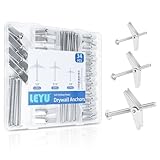
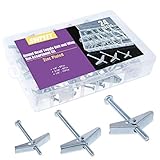
A traditional toggle bolt has a threaded machine screw and a spring-loaded pair of wings. You fold the wings, push them through a drilled hole, and let them open inside the cavity. Tightening the screw pulls the wings against the back of the drywall. The wings are wide, so they can support substantial loads when installed correctly, but the screw and fixture must stay aligned with the wings while you start tightening.
A molly bolt is a metal sleeve with a flange at the front. Tightening its screw pulls a part of the sleeve toward the flange, making the sleeve buckle outward behind the drywall. That expanded sleeve resists pulling out and helps keep the anchor from spinning. Some molly bolts are designed to be set with a dedicated tool; others can be expanded by tightening the screw. Follow the package directions for the specific anchor.
Quick comparison
| Feature | Toggle bolt | Molly bolt |
|---|---|---|
| Best fit | Heavier loads, larger brackets, open wall cavity | Light to medium loads and fixtures that need a neat, reusable screw point |
| Hole size | Often relatively large; check the wing and package dimensions | Usually smaller than a comparable toggle, but varies by size |
| Installation | Wings must pass through the hole and open behind the wall | Sleeve must expand evenly without spinning |
| Removing the screw | Wings may fall into the cavity when the screw is removed | Many versions leave the sleeve in the wall for later screw removal |
| Main failure risk | Wrong hole size, wings that cannot open, or drywall crushing | Anchor spinning, poor expansion, or sleeve tearing through weak drywall |
Choose by load and fixture
For a towel bar, small shelf, or light wall accessory, a properly sized molly is often the more convenient choice. Its screw can usually be removed without losing the anchor, which helps when taking down the fixture for painting or maintenance. The cheaper molly is fine when the load is modest, the drywall is sound, and the manufacturer’s rating covers the job.
For a heavier bracket, a large mirror, or a fixture that puts more force on the wall, a toggle is often the better of these two options because its wings spread the load across a larger area behind the drywall. A toggle bolt assortment can cover several screw sizes, but do not treat a package’s maximum rating as a universal safe load. Ratings depend on drywall thickness, anchor size, installation, and whether the force pulls straight out or acts as a lever.
A projecting shelf or long bracket creates leverage: the farther the load sits from the wall, the more force it applies at the fasteners. A pair of anchors supporting a shallow, lightly loaded shelf is not equivalent to the same pair holding a deep shelf packed with books. For heavy, valuable, or overhead loads, fasten into a stud or use a mounting system specifically rated for the fixture rather than relying on hollow-wall anchors alone.
Check the wall before drilling
Confirm that the wall is drywall over an open cavity, not plaster, tile, or a location blocked by a stud or masonry. Use a stud finder, then check for wiring and plumbing before making a hole. Keep away from likely cable and pipe routes, especially directly above or below outlets and plumbing fixtures. If the anchor lands on a stud, use an appropriate screw into the stud instead of an expansion anchor.
Check drywall thickness and anchor specifications. Many homes use 1/2-inch drywall, but 5/8-inch board is common in some locations; an anchor must be suited to the actual board and cavity depth. A toggle’s wings need enough room to open. Insulation, a pipe, or a second layer of material can block them. A molly also needs clearance behind the board for its sleeve to expand.
Install without damaging the board
Mark the hole carefully and drill the diameter specified on the package. A cordless drill with a sharp bit gives better control than forcing a screw through the drywall. For a toggle, use the exact hole size: too small and the wings will not pass through; too large and the fixture may not cover the opening or the anchor may have inadequate support. Fold the wings in the correct direction, insert them, and keep the screw from backing out while you tighten.
For a molly, push the flange flat against the wall and expand the sleeve as directed. A molly bolt setting tool can help set compatible anchors evenly and reduce the chance of spinning. Stop when the flange is snug; overtightening can crush the drywall and weaken the hold. If the anchor spins, do not keep driving the screw. Remove it if possible, inspect the hole, and use a correctly sized replacement in sound material.
When fastening the fixture, tighten until it is secure, not until the drywall dimples. A slipping clutch on a cordless drill can help limit torque; a hand screwdriver gives finer control for the final tightening. Do not use an impact driver to expand or tighten small drywall anchors. Its fast impacts can strip threads, spin a molly, or crush the board before you notice.
When neither is the right choice
Drywall anchors are only as reliable as the board around them. Avoid both types in soft, cracked, damp, or previously damaged drywall, and do not reuse a hole that has torn wider. For a load that will be moved often, pulls outward, or could injure someone if it falls, locate framing or install blocking. If you cannot reach a stud, choose an anchor rated for the material and load, use the required number and spacing, and leave a safety margin rather than relying on the highest number printed on the package.