Key takeaways
- A driller's practical guide to buying a cordless drill with two batteries, including which pack sizes matter and when a single battery is enough.
What's inside
- Two-battery kits at a glance
- Why a cordless drill with two batteries is the right default
- Amp hours, brushless motors, and what actually changes runtime
- Technique: making the batteries last longer than the spec sheet suggests
- Where two-battery kits fall short
- Choosing your platform, because that is the real decision
- FAQ
- Related Guides
- Two-battery kits at a glance
- Why a cordless drill with two batteries is the right default
- Amp hours, brushless motors, and what actually changes runtime
- Technique: making the batteries last longer than the spec sheet suggests
- Where two-battery kits fall short
- Choosing your platform, because that is the real decision
- FAQ
- Related Guides
As an Amazon Associate I earn from qualifying purchases. This post may contain affiliate links at no extra cost to you.
Nothing kills a day faster than a drill going soft halfway through a deck ledger. You feel it before the tool tells you: the chuck starts hunting, the driver stops seating screws flush, and you end up leaning on the trigger instead of letting the motor work. That is the case for buying a cordless drill with two batteries rather than a bare tool and one pack. One battery in the tool, one on the charger, and you never stop to think about it again.
I have been drilling holes for a living long enough to have owned every wrong version of this setup. One battery and a slow charger. Two batteries that were both too small. A big 5.0Ah pack that made a light drill feel like a brick on an overhead job. So let me walk you through what actually matters in a two-battery kit, what the marketing glosses over, and how to match the pack to the hole you are drilling.
As an Amazon Associate we earn from qualifying purchases at no extra cost to you. Product prices and availability are accurate as of the date shown and are subject to change.




Two-battery kits at a glance
Broadly, drill kits with a pair of batteries land in four buckets. Prices move constantly and vary by promo season, so treat these as categories rather than quotes.
| Kit type | Typical battery pair | Best for | Watch out for |
|---|---|---|---|
| 12V subcompact | Two 2.0Ah packs | Cabinets, trim, electrical, overhead | Runs out of torque in big augers |
| 18V/20V brushed combo | Two 1.5-2.0Ah packs | Homeowner repairs, flat-pack, light framing | Small packs sag under load |
| 18V/20V brushed motor kit | One 2.0Ah + one 4.0-5.0Ah | All-around remodeling | Nose weight with the big pack |
| 18V/20V high-output kit | Two 5.0Ah+ packs | Hole saws, mixing, self-feed bits | Heavy, and overkill for trim work |
The mixed kit in row three is the sleeper pick and the one I recommend most often. A small pack for balance when you are working off a ladder or driving cabinet screws, a fat pack when you need to punch a 2-inch hole through a joist. Manufacturers have caught on and more kits ship this way than they used to.
Why a cordless drill with two batteries is the right default
Charge time is the whole argument. A modern rapid charger will take a mid-size pack from empty to usable in the time it takes to have a coffee, but that only helps if you have a second battery in the tool while it happens. With one pack, your charger is a stopwatch counting down your workday. With two, the charger is just furniture.
There is a longevity angle too. Lithium packs age from heat and from being run flat repeatedly. When you rotate two batteries, each one sees roughly half the cycles and gets a chance to cool between rounds. I have packs on my own shelf that are years old and still hold a usable charge, and the only thing I did differently from the ones that died young was rotate them and stop leaving them baking in a truck bed in July.
The economics favor kits as well. Buying a bare tool plus a battery plus a charger separately usually costs more than the kit that includes all three, sometimes noticeably more. If you are entering a battery platform for the first time, buy the kit.
18V/20V two-battery drill/driver kits
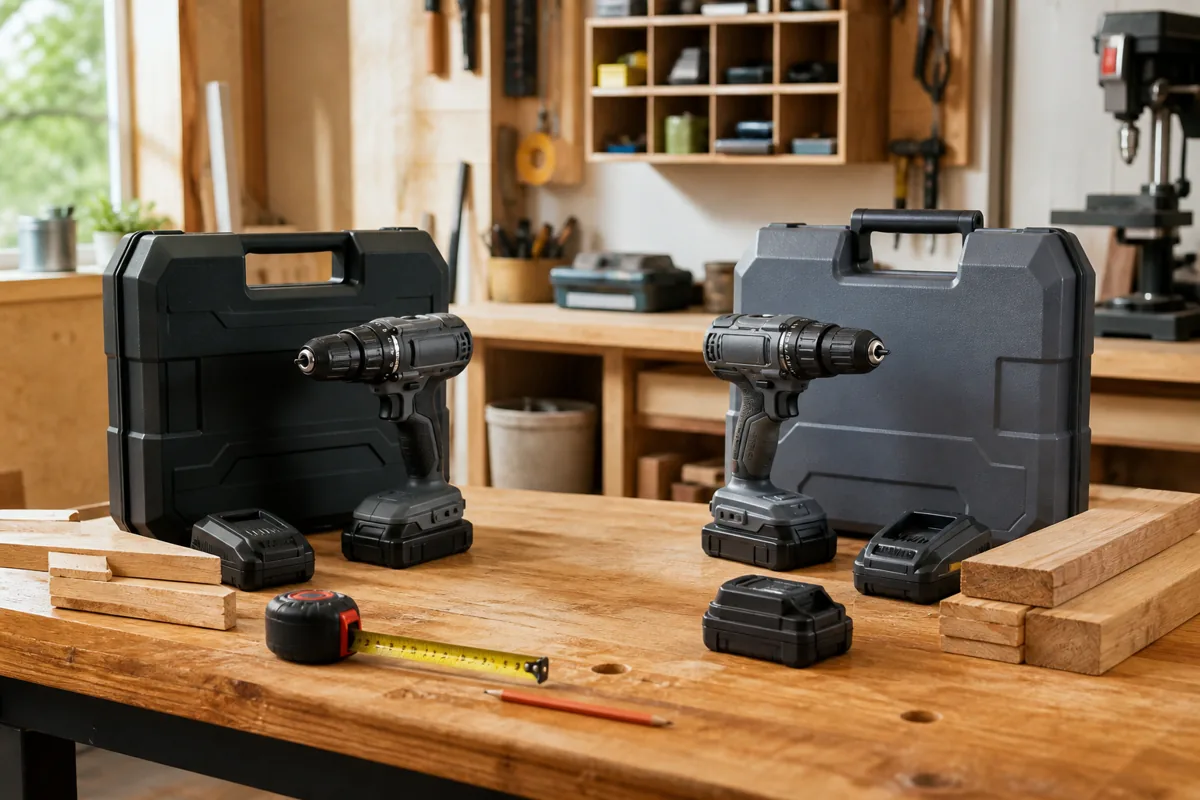
This is the sweet spot for most people: a brushless drill, two packs, a charger, and a bag. Look for a kit that pairs a compact battery with a larger one so you can trade weight for runtime depending on the job. If both packs listed are 1.5Ah, keep shopping unless the price is very low, because small packs sag hard under real drilling loads.
Amp hours, brushless motors, and what actually changes runtime
Amp hours are a fuel tank measurement, not a power measurement. A 5.0Ah pack does not make your drill stronger than a 2.0Ah pack in any meaningful sense on light work. It makes it run longer, and on high-drain work it also sags less, which feels like more power because the motor holds its speed under load. Voltage is what determines the ceiling, and among 18V and 20V MAX tools, that number is essentially the same regardless of what the label says.
Brushless matters more than most spec-sheet lines. A brushless motor wastes less energy as heat, so the same battery lasts noticeably longer and the tool stays cooler during repetitive driving. It also lets the tool modulate torque more intelligently. If your budget forces a choice between a brushless drill with two small packs and a brushed drill with two big packs, I take brushless every time. You can always buy a bigger battery later.
The other spec worth reading is the clutch and chuck. A 1/2-inch all-metal chuck holds spade bits and hole saw arbors without slipping. A 3/8-inch plastic-jaw chuck will let a big bit spin in place and chew the jaws. If you plan on anything beyond 3/8-inch holes, insist on the metal 1/2-inch chuck.
Technique: making the batteries last longer than the spec sheet suggests
Half the runtime complaints I hear are technique problems, not battery problems. Drilling correctly is efficient, and efficient drilling drains less current.
Match speed to bit diameter. Low gear, high torque for anything over 1/2-inch and for all driving. High gear for small twist bits in wood and metal. A 2-inch self-feed bit spun in high gear is a battery-killing, wrist-twisting mistake. Big bit, slow speed, steady pressure.
Let the bit cut, do not push it. Excess pressure stalls the motor, and a stalled motor is a short circuit with a fan. You want just enough pressure that chips keep evacuating. If chips stop coming out, back the bit out to clear the flutes rather than leaning harder.
Pilot holes are a battery saver. A 3-inch structural screw driven dry into dense fir pulls serious current. A properly sized pilot, or even just a wax stick on the threads, cuts that draw substantially and keeps the screw head from cammin out. I pilot with a bit roughly the diameter of the screw’s shank, not the threads.
Stop feathering the trigger. Partial trigger for long stretches runs the motor inefficiently and heats the electronics. Start slow to set the bit, then commit to full speed in the correct gear.
Charge warm, not hot. A pack straight off a hard job is hot enough that most chargers will refuse it or throttle the charge. Give it a few minutes in the shade first. Never charge a pack that has been sitting in a hot vehicle.
12V subcompact drill kits with two batteries
If most of your work is cabinets, trim, electrical boxes, or anything overhead, a 12V class kit with two small packs will do more for you than a heavier 18V tool. The weight difference at the end of a shift is real, and two batteries means the modest capacity of each pack never becomes a problem.
Where two-battery kits fall short
They are not automatically the right answer. If you already own three packs on a platform, a bare tool is cheaper and you are just adding chargers and clutter. And some bundles pad the box with two of the smallest possible batteries to hit a price point, which leaves you with a drill that stalls in anything dense.
- ✔ No downtime waiting on a charger
- ✔ Each pack sees fewer cycles, so both last longer
- ✔ Kits usually cost less than buying tool, battery, and charger separately
- ✔ A mixed pair lets you choose weight or runtime per job
- ✘ Some kits include two undersized packs to hit a price
- ✘ Two large packs add real cost and weight you may not need
- ✘ Redundant if you already own batteries on that platform
- ✘ Single-port chargers still bottleneck if you drain both packs
One more thing on chargers. A kit with two batteries and a slow single-port charger is only half a solution if you are driving screws all day. Check whether the included charger is the rapid version. If it is not, a better charger is one of the cheapest upgrades you can make.
Choosing your platform, because that is the real decision
The drill is temporary. The battery mount is forever. Once you own three or four packs on DeWalt’s 20V MAX XR line, or Milwaukee M18 FUEL, or Makita LXT, every future purchase is steered by that choice, and switching means eating the cost of your battery collection.
So pick based on the tools you will want in two years, not just the drill in front of you. All three of those lines have broad, mature catalogs. Ryobi ONE+ is worth a serious look if you are a homeowner rather than a pro, because the platform is enormous and the cost per battery is low. Bosch and Metabo HPT both make excellent tools with somewhat narrower lineups. Where I get cautious is house brands with no clear commitment to keeping that battery format alive, because a stranded platform means a stranded battery investment.
Drill and impact driver combo kits
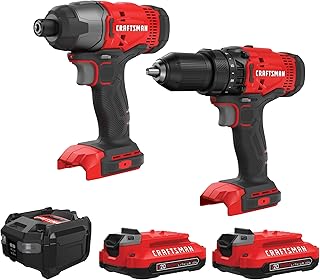
Honestly, the smartest buy for most people is not a drill alone. A drill plus impact driver combo kit typically ships with two batteries and a charger for close to the price of a premium drill kit, and having a dedicated driver means you stop swapping bits constantly. Drill in one hand, driver in the other, both fed by the same pair of packs.
FAQ
Do I really need two batteries, or is one enough? If you use a drill a few times a year for furniture and picture hangers, one pack is genuinely fine. If you work in stretches of more than about half an hour, or you are on a jobsite where stopping is expensive, get two. The upcharge on a kit is usually modest compared to buying a second pack separately later.
Can I mix battery sizes on the same drill? Yes, as long as they are the same platform and voltage class. A 2.0Ah and a 5.0Ah pack both work in the same tool. The larger one runs longer and holds voltage better under heavy load; the smaller one keeps the tool light and balanced. Mixing them on purpose is a feature, not a compromise.
How should I store batteries over the winter? Somewhere indoors and dry, at roughly a half to three-quarter charge, off the tool and off the charger. Cold storage will not destroy a lithium pack but do not charge one that is below freezing. Bring it up to room temperature first. What actually kills packs is heat and leaving them fully drained for months.
Buy the kit, rotate the packs, drill in the right gear, and this stops being something you think about. Two batteries turns a drill from a tool with a timer on it into a tool that is just ready when you pick it up.
Check prices on Amazon →