Key takeaways
- A veteran driller's practical guide to choosing a drill and impact driver combo kit that actually fits homeowner work, without paying for contractor features you will never use.
What's inside
As an Amazon Associate I earn from qualifying purchases. This post may contain affiliate links at no extra cost to you.
Most homeowners buy a drill, use it for a curtain rod, then discover six months later that the same drill is chewing up screw heads on a deck repair and stalling in a masonry wall. That is not a bad drill, that is the wrong tool for half the jobs. The best drill driver combo for homeowners solves this by giving you two machines that share batteries: a drill/driver for holes and delicate fastening, and an impact driver for long screws, lag bolts and anything that wants to fight back.
I have spent a long career making holes in things for money, and the mistake I see most often is people shopping on torque numbers printed on the box. Those figures come from stall tests you will never replicate on a Saturday. What actually matters is chuck quality, clutch behavior, battery platform, and whether the tool is light enough that you still want to hold it overhead twenty minutes into a job. Let me walk you through it the way I would if you handed me your shopping list.
As an Amazon Associate we earn from qualifying purchases at no extra cost to you. Product prices and availability are accurate as of the date shown and are subject to change.




Quick comparison: what to match to your work
Before brands, decide which tier you actually live in. Homeowner work spans a wider range than people admit, and the honest answer for most readers is the middle row.
| Tier | Typical work | Drill you want | Impact driver you want | What you give up |
|---|---|---|---|---|
| Light duty | Curtain rods, flat-pack, small shelves, drywall anchors | 12V compact drill/driver | 12V impact driver | Masonry drilling, big hole saws |
| All-around homeowner | Decks, fence repair, cabinets, hanging heavy items, occasional brick | 18V/20V brushless hammer drill | 18V/20V brushless impact driver | Almost nothing you will miss |
| Heavy remodel | Ledger boards, framing, large auger and hole saw work | 18V/20V high-output hammer drill | High-torque impact driver or impact wrench | Compactness and some cash |
Notice that the drill changes more than the impact driver as you move down that table. Impact drivers are close to a solved problem at this point, even the mid-tier ones drive a 3-inch deck screw without complaint. Drills are where the money shows up, in the chuck, the clutch and the low-speed control.
Voltage, brushless motors and the honest case for 12V
The industry has trained everyone to ask for 18V or 20V MAX, which are the same nominal thing under different marketing names. That is a fine default. But I want to make the case for 12V, because a lot of homeowners would be happier with it and never hear that from a sales floor.
A modern brushless 12V drill weighs around two pounds with a compact battery, fits in a kitchen drawer, and will drill hundreds of pilot holes in pine on one charge. It fits inside a cabinet box where an 18V tool cannot go. If your work is furniture, shelving, electrical plates and general house upkeep, a 12V combo is the tool you will actually pick up instead of leaving in the garage.
Move up to 18V/20V when any of the following is true: you drill masonry more than once or twice a year, you use hole saws above about 2 inches, you own a deck, or you want one battery platform that will later run a circular saw, reciprocating saw, string trimmer or leaf blower. That last reason is the real one for most people. The battery platform is a bigger long-term decision than the drill.
Brushless is worth paying for in either voltage. It is not marketing. A brushless motor has no carbon brushes to wear, runs cooler, and draws current in proportion to load, which in practice means noticeably more holes per charge and a tool that does not get hot and sluggish during a long fastening session. Brushed kits still make sense as a budget entry, and I will not tell you a brushed drill cannot hang a shelf, but the price gap has narrowed enough that brushless is my default recommendation.
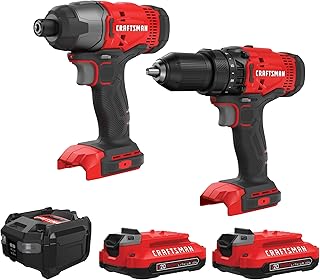
18V/20V brushless drill and impact driver combo kit
This is the sweet spot for a homeowner who owns a house rather than an apartment. Look for a two-tool kit with a hammer drill mode, a 1/2-inch metal-jacketed chuck, two batteries and a real charger rather than a trickle charger. DeWalt XR, Milwaukee M18 FUEL and Makita LXT all field kits in this shape, and the deciding factor should be which platform has the other tools you might buy later.
Chuck, clutch and the details that separate good from frustrating
Here is where I get specific, because these are the things that make you swear at a tool.
Chuck size and construction. A 1/2-inch chuck accepts more bits and grips large round shanks better than a 3/8-inch. More important than the size is whether the chuck has a metal jacket and whether it is a single-sleeve ratcheting design. A cheap all-plastic chuck lets a twist bit slip under load, and once a bit spins in the jaws it scores the shank and never grips properly again. Grab the sleeve on any drill you are considering and see if it feels like a machined part or a bottle cap.
The clutch. The numbered ring on a drill/driver is a torque-limiting clutch, and it is the reason a drill/driver still belongs in your kit next to an impact driver. Setting the clutch low is how you drive brass hinge screws without snapping the heads, and how you seat a screw flush in a cabinet face without dishing the veneer. Impact drivers have no clutch, only speed settings, so they are wonderful at power and poor at finesse. Anyone telling you an impact driver replaces a drill has never installed a hinge.
Two-speed gearbox. Low gear gives torque and control for large-diameter bits, hole saws and driving. High gear gives the RPM you need for small twist bits in wood and metal. If a drill has only one speed, it is a compromise tool. Skip it.
Hammer function. A hammer drill adds a percussion mode for masonry and concrete. It is worth having on an 18V/20V homeowner drill because concrete work shows up unannounced, usually as a mailbox post or a handrail. For anchors larger than about 3/8-inch in cured concrete, though, a cordless hammer drill starts to struggle and a rotary hammer with SDS-Plus bits is the right tool. Rent one for the day rather than buying.
Technique: how to actually use the pair
A combo kit is only as good as the hands on it. This is the part nobody puts in the manual.
Pilot holes. Match the pilot to the screw’s shank, not its threads. In softwood, a pilot roughly equal to the screw’s core diameter is about right; in hardwood, oak or maple, go slightly larger and add a countersink. If you can push the screw into the pilot hole by hand and it stops with light resistance, you are close. Skipping pilots in hardwood or near board ends is how you split trim and snap screws.
Speed and pressure. Big bit, low speed, steady pressure. Small bit, high speed, light pressure. Let the bit cut rather than forcing it. In metal, slow the drill down and add a drop of cutting oil; heat is what kills bits, and a blue-tipped bit is a dead bit. In tile, start with the drill off percussion, use a carbide or diamond bit, and keep the surface wet.
Breakthrough control. Ease off pressure as the bit exits the far side. That is when a spade bit or hole saw grabs and twists the tool out of your hands. Use the side handle if your drill came with one, and keep your wrist braced against the possibility of a stall. A high-torque drill in low gear can absolutely sprain a wrist.
Impact driver habits. Push straight and firmly into the fastener, and use the tool’s lowest speed mode to start the screw before pulling the trigger fully. Impact drivers take 1/4-inch hex shank bits only, and cheap bits snap and cam out. Buy impact-rated driver bits; they use a softer, more forgiving steel that flexes rather than shatters. A torsion-zone bit in a #2 Phillips or T25 will outlast a handful of hardware store bargain bits.
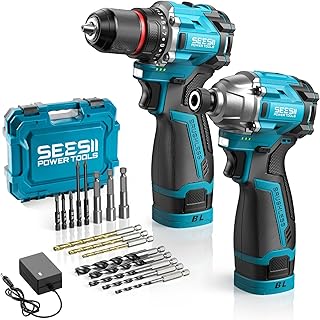
12V compact brushless drill and impact driver kit
If your heaviest job is a floating shelf or a flat-pack wardrobe, a 12V kit is genuinely the better buy. It is light, it fits behind a toilet or inside a cabinet, and you will not resent carrying it up a ladder. Just be clear-eyed that concrete anchors and 4-inch hole saws are out of scope.
What a homeowner combo kit gets right and wrong
- ✔ Two batteries and a charger cost far less bundled than bought separately
- ✔ The impact driver saves the drill’s chuck and clutch from abuse
- ✔ Shared platform opens the door to saws, sanders and yard tools later
- ✔ Brushless models hold usable power deep into the battery charge
- ✔ You stop swapping between a drill bit and a driver bit every thirty seconds
- ✘ Kit batteries are often the smallest capacity the brand sells
- ✘ Bundled bit sets are usually filler, not impact-rated
- ✘ Hard plastic cases take up more shelf space than the tools deserve
- ✘ Switching platforms later is expensive, so the first choice locks you in
- ✘ High-torque marketing numbers rarely reflect real homeowner tasks
On batteries specifically: a kit with two compact packs is fine, and often better than one large pack, because you can keep drilling while the other charges. If your kit comes with 1.5Ah or 2.0Ah batteries and you later find yourself running out mid-project, buy a single higher-capacity pack rather than a whole new kit. Also check that the included charger is a standard fast charger. Some budget bundles ship a slow charger to hit a price point, and waiting an hour and a half for a battery ruins an afternoon.
Frequently asked questions
Do I really need both a drill and an impact driver? Need is a strong word, but the pair covers work neither does alone. The drill holds round-shank bits and has a clutch for controlled fastening; the impact driver delivers rotational hammer blows that drive long screws and lag bolts without wrecking your wrist or the screw head. If you own a house with any outdoor structure, you will use both within the first month.
Is a hammer drill enough for concrete, or do I need a rotary hammer? A cordless hammer drill handles small anchors, roughly up to 3/8-inch, in block and cured concrete, and that covers most homeowner anchoring. Above that size, or for repeated holes, a rotary hammer with SDS-Plus bits does in seconds what a hammer drill grinds away at for minutes. Rent the rotary hammer for the one weekend you need it.
Should I buy a brand-name kit or a budget brand? Buy into the platform you will grow with. The major lines, DeWalt XR, Milwaukee FUEL, Makita LXT and Ryobi ONE+ for value, all have deep tool ranges and batteries you can still buy in five years. Budget house brands can be perfectly good tools, but if the platform disappears, so does your battery supply, and that is the expensive part of the system.
My summary is unglamorous: for most readers, an 18V or 20V brushless two-tool kit with a hammer drill, a 1/2-inch metal chuck and two batteries is the right answer, and the brand matters less than the platform’s future. Buy a decent set of impact-rated bits alongside it, learn to pilot properly, and that kit will outlast several of the projects you bought it for.
Check prices on Amazon →