What's inside
As an Amazon Associate I earn from qualifying purchases. This post may contain affiliate links at no extra cost to you.
What we cover
What lightweight block needs from a drill
Lightweight concrete block is easier to drill than dense poured concrete, but it can still frustrate the wrong tool. The material is porous and relatively soft; its hollow cores and thin face shells can crumble if you push hard or use an oversized bit. For a few small holes for lightweight shelves or cable clips, a decent cordless drill and a masonry bit may be enough. For repeated holes, larger diameters, or tougher block, a hammer drill saves time.
For most household work, look for a cordless hammer drill with a selectable hammer mode, a two-speed gearbox, and a clutch. A 1/2-inch chuck is useful if you may use larger bits, though many common anchor holes need only a 1/4- or 5/16-inch bit. A 18V or 20V-class tool offers comfortable capacity; compact 12V models can handle occasional small holes if you let the bit do the work.
As an Amazon Associate we earn from qualifying purchases at no extra cost to you.
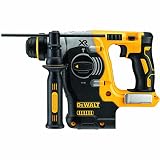


Choose the tool for the hole count
| Tool | Best use in lightweight block | Main trade-off |
|---|---|---|
| Standard cordless drill | One or two small holes, especially in soft block | Slow drilling; forcing it can overheat the bit or stall the motor |
| Cordless hammer drill | Regular anchor holes and varied masonry work | Heavier and noisier; hammering can damage a thin block face if pressed too hard |
| Rotary hammer | Many holes, larger diameters, or hard masonry | Usually excessive for a few small holes in lightweight block |
A hammer drill combines rotation with a rapid, short hammering action. It is a practical all-around purchase if you already need a drill for wood, metal, and screws. Compare 18V cordless hammer drills by battery platform, weight, and chuck capacity rather than headline torque alone. Torque matters more for driving fasteners; drilling masonry depends heavily on the bit, hammer action, and steady technique.
A rotary hammer uses a different mechanism and hits harder. It is worth considering for a renovation with dozens of holes or for dense concrete, but it can break up lightweight block around a small hole. For routine anchors, the hammer drill is generally easier to control.
Match the bit to the anchor
Use a carbide-tipped masonry bit sized to the anchor maker’s instructions. Do not assume a larger hole is safer: an oversized or ragged hole may leave an anchor loose, while a hole that is too small can split the block or prevent the anchor from seating. If the package calls for a 1/4-inch hole, use that diameter, not a nearby metric size unless the dimensions match.
Lightweight block can have a thin face over a hollow core. Before drilling, check the wall for wiring and plumbing, then mark the hole and use a depth stop or tape on the bit. Many small anchors need roughly 1 to 1 1/2 inches of embedment, but the anchor’s stated depth governs. Choose an anchor rated for the block and the load. Plastic expansion plugs may work for light items; heavier fixtures may call for a masonry screw or a suitable hollow-block anchor. A strong drill does not make an unsuitable anchor reliable.
For occasional work, a set of carbide-tipped masonry bits is a reasonable starting point. Cheap bits are fine for a few clean holes, but they can blunt quickly in abrasive material. If progress slows or the bit begins to wander, stop and inspect it rather than leaning harder.
Drill without breaking the face
Start with hammer mode off. Run the bit slowly to establish a shallow guide, then switch hammering on if the bit is cutting poorly. Keep the drill square to the wall and apply steady, moderate pressure. Excessive force does not make the hammer mechanism work better; it can chip the opening or punch through the face shell abruptly. Ease off as the bit approaches the marked depth.
Pull the bit back occasionally to clear dust, particularly in a deep hole. Masonry dust can pack around the flutes and make a bit bind. Wear eye protection and a suitable dust mask, and keep your face out of the dust path. If the drill stalls, release the trigger. A bit wedged in a hollow section can twist the tool sharply, so use the side handle on a larger drill when available.
After drilling, clear loose dust from the hole with a vacuum or the cleaning method specified for the anchor. Dust left inside can stop an anchor from seating fully. Test-fit the anchor before mounting the load. If the hole has crumbled or is visibly oversized, do not compensate by driving the anchor harder; move to a sound spot or use an anchor designed for the actual block condition.
When a cheaper drill is enough
If you need only a handful of small holes in soft block, a basic cordless drill may do the job, especially with a sharp masonry bit and patience. Buy a hammer drill when you expect repeated masonry work, want one drill for several materials, or find that ordinary drilling takes too long. If you already own compatible batteries, staying on that platform often saves more than buying a bare tool from a different system.
For a compact option, compare 12V cordless hammer drills for small anchors and occasional use. They are lighter, but may drill slowly in harder block and can have less reserve for larger bits. If the job involves many holes or bits above about 3/8 inch, a full-size hammer drill is the safer buy. For a single small project, borrowing or renting is often more sensible than paying for power you will rarely use.