What's inside
As an Amazon Associate I earn from qualifying purchases. This post may contain affiliate links at no extra cost to you.
Attaching a ledger board to concrete is not a job for ordinary wood screws or plastic wall plugs. A ledger carries floor, deck, porch, or stair loads, and a failed connection can pull out of the wall or split the concrete. The right fastener depends on the concrete’s strength, thickness, age, condition, and whether the ledger is supporting a structure covered by local building code.
For most sound, solid concrete, the best general-purpose choices are concrete screw anchors, wedge anchors, and adhesive anchors. Each has a different installation method and failure risk. Before drilling, confirm the ledger size, fastener spacing, edge distances, and required connection with your local code or a qualified contractor. A ledger attached to a foundation wall is not the same as a light-duty board used for shelving.
As an Amazon Associate we earn from qualifying purchases at no extra cost to you.



What we cover
Best fastener types for concrete
| Fastener | Best use | Advantages | Limitations |
|---|---|---|---|
| Concrete screw | Light- to medium-duty ledger attachments in solid concrete | Fast installation, removable, inexpensive | Lower capacity than properly installed expansion or adhesive anchors; requires a correctly sized hole |
| Wedge anchor | Heavy-duty connections in sound, thick concrete | High strength, predictable holding power, widely available | Permanent, needs accurate drilling and adequate edge distance |
| Sleeve anchor | Medium-duty connections and hollow concrete block | Works in some masonry situations; available in many sizes | Generally less capacity than wedge anchors; performance varies in hollow material |
| Adhesive anchor | High-load or close-to-edge connections designed by an engineer | No expansion pressure; useful where expansion anchors cannot be used | Expensive and highly sensitive to hole cleaning, temperature, and cure time |
Concrete screws: the practical budget choice
Heavy-duty concrete screws are often the simplest choice for a small ledger or nonstructural attachment. They cut threads into a predrilled hole and do not require a separate nut. Look for a diameter and length approved for the intended load, not just the largest screw that fits through the board. A common installation uses a 1/4-inch or 5/16-inch screw with at least 1-1/2 to 2 inches of embedment in solid concrete, but the manufacturer’s load table controls.
Use a heavy-duty concrete screw with its specified masonry bit. Drill through the ledger first, then into the concrete, keeping the drill perpendicular. A hammer drill is normally required; an impact driver is useful for driving the screw, but it does not replace the hammer drill and masonry bit needed to make the hole.
Concrete screws are a poor choice when the connection is carrying substantial deck or floor loads unless the fastener’s engineering data and the building code specifically allow them. They can strip the concrete threads if overdriven, and dust left in the hole can reduce holding power. If the screw spins without tightening, remove it and repair or relocate the connection rather than assuming it will hold.
Wedge anchors: the stronger conventional option
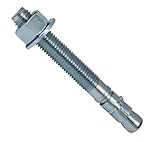
Wedge anchors are a good choice for a structural ledger on a solid, sufficiently thick concrete foundation. The anchor is installed through the ledger and tightened with a nut. Tightening pulls the tapered stud into an expansion clip, which grips the sides of the drilled hole.
A typical heavy-duty installation may use 1/2-inch-diameter wedge anchors, but diameter, embedment, spacing, and edge distance must come from the anchor manufacturer and the project design. The hole is usually the same diameter as the anchor, and embedment commonly falls around 2-1/2 to 4 inches. Do not guess: too little embedment reduces capacity, while drilling too close to an edge can split or blow out the concrete.
Use a concrete wedge anchor when you need a robust mechanical connection and have enough concrete behind the ledger. A rotary hammer with an SDS-Plus masonry bit makes repeated holes much faster than a basic hammer drill. A cordless hammer drill can handle a few holes, but expect slower drilling and more battery use.
Adhesive anchors for difficult or high-load connections
Adhesive, or chemical, anchors use threaded rod set into a resin-filled hole. They are useful near concrete edges because they do not exert the same expansion force as wedge anchors. They are also used where a designed connection needs deeper embedment or unusually high capacity.
Installation quality matters more than with most mechanical anchors. Drill the hole to the specified diameter and depth, blow or vacuum out the dust, brush it with the correct tool, and clean it again. Inject adhesive from the back of the hole outward, then twist the threaded rod into place. Observe the product’s cure time, which can range from minutes to many hours depending on temperature.
A concrete adhesive anchor system is not automatically stronger than a wedge anchor. A dusty hole, expired resin, incorrect mixing nozzle, or cold concrete can produce a connection that looks solid but fails under load. Use a listed system with published load values, and follow the instructions exactly.
Drilling and ledger installation details
Inspect the wall before drilling. Avoid embedded electrical conduit, plumbing, and reinforcing steel. A concrete scanner can help, but it is not a guarantee. Never drill through a visibly cracked, loose, or spalled section without addressing the concrete problem first.
Use pressure-treated lumber where required, and place a durable gasket or flashing membrane between the ledger and concrete to limit trapped water. Fasteners should pass through the board with washers where specified. Do not countersink structural anchor heads into the ledger unless the design allows it; reducing the board around an anchor can weaken the connection.
Space anchors away from corners and from one another according to the manufacturer’s table. Tighten nuts with a torque wrench when the instructions specify a torque value. Over-tightening can damage the concrete or crush the wood; under-tightening can leave an expansion anchor improperly engaged.
Tools that make the difference
For occasional work, a cordless hammer drill with masonry bits is adequate for small concrete screws and a few anchors. For multiple 1/2-inch holes several inches deep, choose a rotary hammer and SDS-Plus bits. Use a vacuum or hole-cleaning brush, eye protection, hearing protection, and a dust-control method.
The cheaper concrete screw is fine for many light-duty attachments, but a structural ledger deserves a fastener system with published capacity, correct spacing, and verified installation. If the ledger supports a deck, floor, balcony, or roof, treat the fastener choice as a structural connection—not simply a drilling task.