What's inside
As an Amazon Associate I earn from qualifying purchases. This post may contain affiliate links at no extra cost to you.
For small repairs in brick or concrete block, the right drill depends on the holes you need to make. A regular drill driver can handle occasional small holes in softer masonry with a suitable masonry bit, but it works slowly and puts more strain on the tool. A hammer drill is the better choice for repeated holes, larger anchors, or harder material. The key distinction is that a hammer drill adds a rapid forward tapping action while the bit rotates; an impact driver does not.
As an Amazon Associate we earn from qualifying purchases at no extra cost to you.


What we cover
Identify the material and the repair
Brick and block vary. A hole in a soft brick mortar joint is much easier than one in dense brick or a block face. Mortar is often the sensible place to drill for a light-duty repair if the anchor instructions allow it: it can be easier to drill and less likely to split the brick. But mortar may be too weak for a heavily loaded fixture, and crumbling or deteriorated mortar is not a reliable anchor base.
Before choosing a tool, check the anchor’s required hole diameter and depth. Small plastic plugs commonly call for holes around 1/4 inch, while larger sleeve or masonry anchors may need 3/8 inch or more. The anchor package is the authority. A hole that is too wide, shallow, or full of dust can leave an anchor loose even if the drill did its job.
What each drill does
A drill driver turns a bit without hammering. It is lighter, usually less noisy, and useful for pilot holes, wood, metal, screws, and occasional small masonry holes. On brick or block it relies on the cutting edges of a masonry bit and steady pressure. Expect slower progress, especially in hard material.
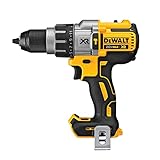
A hammer drill rotates the bit and adds short axial blows. Use its hammer setting with a carbide-tipped masonry bit for brick and block. Switch hammering off for wood, metal, screws, and delicate work. Many cordless models have a clutch and multiple speeds; start slowly to keep the bit from wandering, then use a steady speed without forcing it.
An impact driver delivers rotational impacts to turn fasteners. It is not a substitute for a hammer drill: its impacts twist rather than drive the bit forward. It can install compatible screws and some rated masonry fasteners, but it is not the tool to buy for ordinary drilled anchor holes.
Quick comparison
| Tool | Brick and block performance | Best fit | Main trade-off |
|---|---|---|---|
| Drill driver | Works for small, occasional holes in softer masonry; slow in hard material | A few small holes, plus general household drilling and screwdriving | More time and pressure; bit or motor can overheat if pushed |
| Hammer drill | Faster and more effective for repeated holes and tougher masonry | Multiple anchor holes, larger bits, or regular masonry repairs | Costs more and is noisier; hammer action is unnecessary for most other materials |
| Impact driver | Not intended for standard drilled anchor holes | Driving screws and compatible fasteners | Rotational impacts do not replace a hammer drill’s forward blows |
Which one should you buy?
If you already own a drill driver and need two or three small holes in soft brick or block, try it before buying another tool. Use a sharp masonry bit, drill slowly at first, and stop if progress stalls or the bit gets hot. A drill driver is the cheaper option when the work is genuinely occasional and the material is forgiving. Do not compensate for poor progress by leaning hard on the tool; that can bend or overheat the bit, strain the drill, and leave an oversized hole.
If you are buying a tool specifically for several masonry repairs, choose a cordless hammer drill. It also works as a regular drill when hammer mode is off, so it can cover common household jobs. For one repair, renting or borrowing may make more sense than paying for a tool you rarely use.
For a home kit used mostly on wood, furniture, and small screws, a cordless drill driver remains a sensible first purchase. Buy a hammer drill only when masonry work is frequent enough to justify it. An impact driver is a useful companion for driving screws, not a replacement for either drill when making anchor holes.
Drill a clean anchor hole
Use a carbide-tipped masonry bit in the exact diameter specified for the anchor. Mark the location, check for hidden wires or pipes, and hold the drill square to the surface. On brittle brick, avoid drilling too close to an edge; as a practical starting point, keep the hole at least about 1 inch from an edge unless the anchor maker or project requires more. The risk of cracking rises with larger holes and narrow margins.
Start without hammer action if the bit is wandering on a smooth surface; once it has a shallow guide, engage hammer mode if needed. Apply firm, even pressure, but let the bit cut. Pull it out occasionally to clear dust. For a deep hole, drill in short stages rather than forcing through packed debris. Wear eye protection, and use a dust mask when working in masonry dust.
Stop if the hole suddenly becomes loose, the brick cracks, or the bit hits something unexpected. A spinning bit that makes little progress can mean a worn bit, hard aggregate, or a tool that is underpowered for the task. Repeatedly widening the hole is not a reliable fix: the anchor may no longer grip. Use the specified anchor and keep its load rating, installation instructions, and the condition of the masonry in mind—especially for shelves, handrails, and anything overhead.
Common failures to avoid
A masonry bit used without hammer action may still work in soft block, but it can take much longer in hard brick. A wood bit is not an acceptable substitute: it can overheat, dull quickly, and make a ragged hole. Likewise, using hammer mode on a screw or ordinary drill bit can damage the fastener, bit, or workpiece.
If an anchor turns when you tighten the screw, remove it and inspect the hole. Dust, an oversized hole, damaged masonry, or an unsuitable anchor may be the cause. Clean the hole as directed by the anchor manufacturer and choose a suitable repair method rather than overtightening. In weak or crumbling block, a stronger drill will not make the material stronger; select an anchor designed for that substrate or move the fixing point to sound material.