What's inside
As an Amazon Associate I earn from qualifying purchases. This post may contain affiliate links at no extra cost to you.
What we cover
What matters for repeated holes in aluminum
For a run of holes in aluminum, a drill’s control and heat management matter more than its headline torque. Aluminum is soft, but it grabs cutting edges readily. A dull bit, excessive pressure, or a high-speed drill that bogs down can leave rough holes, pull the workpiece, or snap a small bit.
Look for a cordless drill with a variable-speed trigger, a two-speed gearbox, and a clutch. The low gear gives better control for larger holes and starting accurately; high gear is useful for small bits when the drill and bit manufacturer recommend higher speed. A side handle is worthwhile for larger holes. You do not need a hammer function for aluminum, and an impact driver is a poor substitute for a drill when hole quality matters.
As an Amazon Associate we earn from qualifying purchases at no extra cost to you.


Drill types compared
| Type | Good fit | Trade-off |
|---|---|---|
| Compact 12V drill | Small bits, thin sheet, light-duty batches | Less reserve for larger holes or long sessions |
| 18V/20V drill-driver | Repeated holes across a broad range of bit sizes | Heavier; high torque can punish a poorly held workpiece |
| Hammer drill | Mixed work that includes masonry | Hammer mode is unnecessary for aluminum; usually adds weight |
| Impact driver | Driving screws and bolts with suitable accessories | Less predictable for clean drilling; avoid for precision holes |
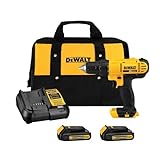
For most people making dozens of holes in sheet, angle, or extrusion, a good 18V/20V drill-driver is the versatile choice. A two-speed cordless drill-driver gives more capacity for larger bits than many compact drills, while still being manageable for ordinary shop work. If the holes are small and the material is thin, a 12V drill can be less tiring and often costs less.
What to look for when buying
Choose a drill with a chuck that accepts your largest planned bit. Most general-purpose drills have a 1/2-inch chuck, but the chuck size alone does not guarantee the drill is suited to large hole saws or step bits. Check the tool’s stated capacity and use the accessory maker’s limits. For holes above roughly 1/2 inch, a low gear, sharp cutter, and firm two-handed grip become increasingly important.
Battery size affects both run time and balance. A 2.0Ah pack is lighter for overhead or repetitive handling; a 4.0Ah pack can reduce interruptions during a long batch, at the cost of extra weight. Buying into a battery platform you already own can be more sensible than choosing a different brand for a small gain in drill performance.
Brushless motors generally use battery energy efficiently and can hold up well under frequent use, but they are not essential for occasional aluminum work. If the cheaper brushed drill has variable speed, a useful low gear, and enough capacity for your bits, it can do the job. Pay for brushless primarily when you expect regular batches or already value the platform.
Bits, speed, and cutting fluid
Use sharp bits intended for metal, such as quality high-speed steel (HSS) or cobalt bits. Cobalt is useful for tougher metals and sustained work, but it is not a cure for poor technique; sharp HSS bits are usually fine for common aluminum alloys. For larger holes in thin stock, a step bit can make clean, round holes with less grabbing than a large twist bit. A metal-cutting bit set with a step bit is a practical starting point if your hole sizes vary.
There is no single correct speed for every alloy, bit diameter, and drill. As a starting point, small bits around 1/8 inch can run faster than larger bits; a 1/2-inch bit should run much slower. Follow the bit maker’s speed chart where available. If the bit squeals, smears metal instead of cutting, or produces hot, discolored chips, stop and correct the speed, sharpness, or feed pressure. Use steady pressure: enough to make the cutting edges form chips, not enough to stall the drill.
A small amount of cutting fluid or lubricant made for aluminum can reduce friction, but some products are unsuitable for aluminum or leave a difficult residue. Check the label. For a short run in thin stock, sharp bits and sensible speed may be enough. Clear chips often; packed aluminum chips can bind the bit and damage the hole.
How to make repeated holes accurately
Mark centers with a scribe or fine marker, then use a center punch lightly if the material is thick enough to take one. A heavy punch can dent thin sheet. Clamp the work securely to a backing board or sacrificial plate, and keep hands out of the bit’s path. For a repeated pattern, use a drill guide, template, or stop rather than measuring each hole independently.
Start the hole with light pressure and keep the drill square to the surface. On thin sheet, a pilot hole is not always necessary; it can make a large bit wander if the pilot is off-center. For thicker stock or larger twist bits, a smaller pilot can help. When the bit is about to break through, ease off pressure. Breakthrough is a common point for grabbing, especially with a large bit in thin material.
Deburr both sides with a deburring tool or a countersink turned gently by hand. Do not use the drill at high speed to force a countersink into soft aluminum; it can chatter and enlarge the opening. Wear eye protection, secure loose sleeves and hair, and remove sharp chips with a brush, not your fingers.
When a different tool is worth it
If you are drilling many accurately spaced holes, a drill press or guided portable drill can improve consistency more than buying a more powerful cordless drill. For a few dozen holes in thin aluminum, a basic drill-driver and sharp bits are generally adequate. For thick plate, large diameters, or production work, consider a more rigid setup and follow the cutter maker’s speed and feed recommendations. A powerful drill is not automatically safer: if a large bit catches, the tool can twist hard enough to injure a wrist or pull the stock from a clamp.