What's inside
As an Amazon Associate I earn from qualifying purchases. This post may contain affiliate links at no extra cost to you.
Hard brick is where an ordinary cordless drill quickly shows its limits. The dense outer face can resist a standard masonry bit, polish the bit’s carbide tip, and overheat a compact motor before the hole reaches the required depth. A good cordless hammer drill makes the job practical, but the drill is only part of the system: hammer action, battery size, masonry bits, drilling technique, and the anchor all matter.
As an Amazon Associate we earn from qualifying purchases at no extra cost to you.


What we cover
What to look for in a hammer drill for hard brick
Choose a full-size cordless hammer drill with a brushless motor, a two-speed gearbox, and a mechanical hammer mode. For occasional holes, an 18V or 20V-class tool with a 1/2-inch chuck is usually the sensible middle ground. It provides enough torque for masonry bits without the bulk and cost of a rotary hammer.
Pay attention to impact rate as well as torque. Hammer drills commonly deliver roughly 20,000 to 35,000 blows per minute. A higher number does not automatically mean faster drilling, but it helps break up hard material when paired with adequate pressure and a sharp bit. A side handle is important. Without it, the drill can twist suddenly when the bit catches aggregate or breaks through the back of the brick.
For repeated work, choose a kit with at least a 4.0Ah battery. A 2.0Ah pack is lighter and adequate for a few holes, but it may run hot during a long series of 1/2-inch holes. If you already own batteries in a tool brand’s system, buying a bare tool is often the best value. Otherwise, compare the cost of the drill, charger, and battery rather than comparing bare-tool prices.
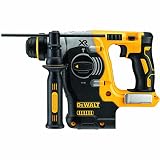
These brushless cordless hammer drills are the right general category for mounting shelves, brackets, conduit, and small fixtures to brick.
Which cordless tool type fits the job?
| Tool type | Best use | Typical limitation |
|---|---|---|
| Compact 12V hammer drill | A few small holes, light-duty anchors, overhead work | Slow in hard brick; limited battery capacity and side-handle control |
| 18V/20V brushless hammer drill | Most homeowner and general repair work | Can struggle with many deep or large holes |
| High-torque 18V/20V hammer drill | Repeated 3/8- to 1/2-inch holes and larger fasteners | Heavier, more expensive, and easier to overwork the bit |
| Cordless rotary hammer | Frequent drilling, holes over 1/2 inch, very hard masonry | Bulkier; usually uses SDS bits rather than standard chuck bits |
A high-torque hammer drill is not automatically better for every user. Its extra weight becomes tiring when drilling above shoulder height, and its clutch may not protect a small anchor screw as gently as a compact drill. If you need four 1/4-inch holes for a light bracket, a midrange drill is enough.
If the job involves dozens of holes, reinforced masonry, concrete lintels, or holes larger than about 1/2 inch, step up to a cordless SDS-plus rotary hammer. Its piston mechanism hits harder than the gear-and-cam mechanism in a hammer drill. It usually cuts faster and with less pressure, though it is the wrong purchase if you only occasionally install a wall plug.
Bits and anchors matter as much as the drill
Use carbide-tipped masonry bits intended for hammer drilling. A cheap bit with a poorly centered tip may wander, make an oversized hole, or lose its cutting edge after two or three holes. For better results, choose a reputable set of carbide-tipped masonry drill bits with the exact diameters required by your anchors.
Check the anchor instructions before drilling. A nominal 1/4-inch wall plug may require a 1/4-inch hole, but some sleeve anchors and specialty fasteners specify a different diameter. Drilling too large a hole leaves the anchor spinning or pulling out. Drilling too shallow leaves dust at the bottom and prevents full seating.
For light loads, plastic expansion plugs can be fine. For shelves, handrails, television mounts, or anything exposed to repeated pulling, use a suitable sleeve anchor, concrete screw, or chemical anchor according to the manufacturer’s instructions. Brick can be weaker than concrete, and the mortar joint is usually a poor location for a heavily loaded fastener.
How to drill hard brick without damaging it
Mark the hole and use a level to lay out multiple fasteners. Start with the hammer function off and run the bit slowly enough to create a shallow pilot mark. This prevents the carbide tip from skating across the glazed face of hard brick. Once the hole is established, engage hammer mode and increase speed gradually.
Keep the drill square to the wall. Apply firm, steady pressure, but do not lean your full body weight on the tool. Excessive pressure can stall the motor, overload the gearbox, and flatten the bit’s carbide cutting edges. Withdraw the bit every 1 to 2 inches to clear dust, especially in deep holes. A partially clogged hole creates heat and makes the drill appear weaker than it is.
For a 1/4-inch hole around 2 inches deep, expect roughly 15 to 45 seconds in hard brick with a good 18V/20V hammer drill and a sharp bit. A 1/2-inch hole may take a minute or more. If progress stops entirely, do not keep forcing the trigger. The bit may be dull, the hole may be packed with dust, or you may have hit a particularly hard inclusion.
Common mistakes and useful buying advice
Do not use an impact driver with a hex-shank masonry bit as a substitute for a hammer drill. It can make occasional small holes, but its pulsing torque is difficult to control and can damage bits or anchors. Do not use hammer mode on tile, hollow brick, or delicate facing material without testing first; percussion can crack the surface.
For the cheapest acceptable setup, buy a midrange cordless hammer drill, a 4.0Ah battery, and a small quality masonry-bit set. Spend more on an SDS rotary hammer only when hole count, diameter, or speed justifies it. The best tool is the one that matches the brick, anchor, and number of holes—not necessarily the one with the highest advertised torque.
For buyers who already have compatible batteries, a bare-tool cordless hammer drill can keep the purchase cost reasonable. Verify that the tool includes a side handle and that your existing battery is large enough for the work.