We research everything we recommend. When you buy through our links, we may earn a commission. As an Amazon Associate we earn from qualifying purchases.
Best Speed Squares for Roofing, Framing and Layout Work
Compare the best speed squares for roofing and framing, from 7-inch belt squares to the Big 12, plus size, material and rafter-table buying tips.
Few tools earn a permanent spot in a tool belt, but the speed square is one of them. The triangular layout tool marks square and 45-degree lines, reads angles like a protractor, guides a circular saw, and carries the rafter scales a roofer needs to lay out common, hip, valley, and jack cuts without a calculator. One square handles work that once took a try square, a miter square, and a framing square together.
The catch is that small differences matter. A 7-inch square lives on a belt and crosses a 2×6 in one pass, while a 12-inch model spans wide stock and stair stringers. Aluminum shrugs off drops that crack composite, etched markings outlast printed ones, and some faces are far easier to read in glare than others. This guide compares five widely sold squares across those differences so the one in your pouch matches the work you actually do.
As an Amazon Associate, we earn from qualifying purchases.
The Swanson S0101 is the default pick for most carpenters: a 7-inch aluminum square with the Blue Book of rafter tables in the box. The Empire e2994 reads easiest in bright light, the Johnson Johnny Square adds magnets for steel work, the Speedlite suits siding, and the Big 12 covers wide stock and stairs.
Swanson Tool S0101 7-Inch Speed Square
Top Pick
Swanson Tool S0101 7-Inch Speed Square
Best for: Framers and DIYers who want the proven all-rounder with rafter tables included.
The S0101 is the original Speed Square design, in production in one form or another since 1925, and it remains the reference point for the category. The body is heavy-gauge aluminum alloy with a matte finish that cuts glare, and the black gradations are stamped deep enough to stay legible after years of belt wear, drops, and saw passes along the edge.
Swanson packs its Little Blue Book of rafter lengths and roof construction in the box, which turns the scales on the face into a complete one-number layout system for common and hip-valley rafters. Scribe notches spaced along the edge handle parallel line marking, and the Diamond cutout helps with seat cuts on rafters. For a first square or a like-for-like replacement, this is the safe buy.
Specs:
– Size: 7 inches
– Material: Heavy-gauge aluminum alloy, matte finish
– Markings: Black gradations, common and hip-valley rafter scales
– Includes: Little Blue Book of rafter tables
– Extras: Diamond cutout, scribe notches, saw-guide edge
Empire Level e2994 7-Inch True Blue Rafter Square
Runner-Up
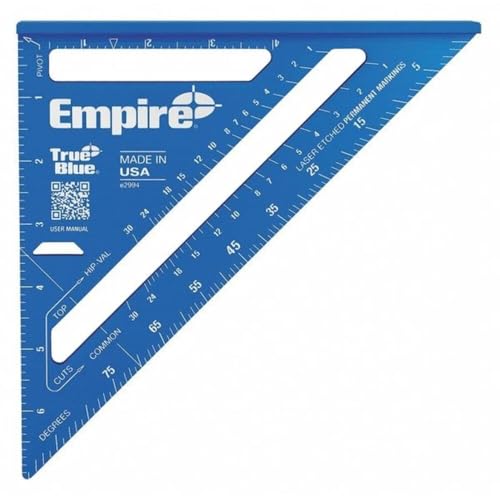
Empire Level e2994 7-Inch True Blue Rafter Square
Best for: Roofers and framers who read scales in bright sun and want markings that will not wear off.
Empire builds the e2994 from extruded, anodized aluminum and finishes it in the brand’s high-visibility blue with white markings. The graduations are laser etched rather than printed or stamped, so the numbers stay crisp instead of polishing away where a saw base or a thumb rubs the face thousands of times.
The heel is wider than on older Empire squares, which gives the fence more bearing surface against a board edge and makes the square sit steadier as a saw guide. A SCRIBE-GUIDE notch pattern marks at quarter-inch and half-inch increments for fast parallel lines, and the face carries common rafter and hip-valley scales alongside the degree scale. It is made in the USA and backed by a limited lifetime warranty.
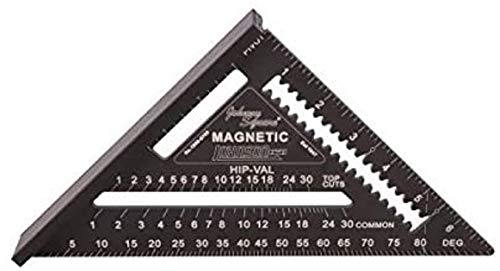
Johnson Level & Tool 1959-0700 Magnetic Johnny Square
The Johnny Square is a 7-inch extruded aluminum square with CNC-machined edges, which keeps the reference faces straight and the 90-degree corner honest. Johnson’s EZ Read finish pairs a black anodized body with bold white markings, and the scales are laser etched for durability.
What sets this model apart is the magnetic face. Rare-earth magnets in the body hold the square to steel studs, metal track, and a miter saw fence, which frees a hand during layout on steel framing and makes the square easy to park on any steel surface in the shop. The thick heel doubles as a solid saw guide, and the face carries the standard degree, common rafter, and hip-valley scales.
The Speedlite takes the Speed Square layout and molds it from high-impact polystyrene composite instead of metal. At 8 inches it is slightly larger than a standard belt square, yet it weighs only a few ounces, and the bright orange body is easy to spot in a pile of offcuts or at the bottom of a tool bag.
The composite body will not mar soft finishes, which is why siding crews favor it: the square rides against vinyl, fiber cement, and painted trim without scratching. Scribe notches are spaced an eighth of an inch apart for parallel lines, a center-line guide helps locate the middle of round stock, and the face keeps the one-number rafter markings. The trade-off is durability, since composite edges nick and wear faster than aluminum under daily saw-guide duty.
The Big 12 scales the classic design up to 12 inches, and that extra reach changes what one square can do. A single placement marks a full line across a 2×12, a sheet of plywood, or a stair stringer, where a 7-inch square needs two placements and invites a kink in the line.
Swanson adds a patented layout bar that clamps to the square and repeats rise-and-run settings, which speeds up stair stringer layout and helps with out-of-square corners. The body is the same heavy-gauge aluminum with a glare-cutting matte finish and black gradations as the 7-inch model, the Blue Book is included, and the longer edge makes a steadier fence for circular saw cuts on wide material. It is too bulky for a belt slot, so it usually lives in the truck or gang box.
Specs:
– Size: 12 inches
– Material: Heavy-gauge aluminum alloy, matte finish
– Markings: Black gradations, common and hip-valley rafter scales
– Includes: Little Blue Book, patented layout bar
– Extras: Full-width marking on 2×12 stock, stair layout support
How to choose
Size first. A 7-inch square is the belt standard: it crosses a 2×6 in one placement, fits a tool pouch, and handles the bulk of framing and trim layout. Step up to 12 inches when the work involves 2×10 and 2×12 stock, sheet goods, deck framing, or stair stringers, where a full-width line in one pass saves real time. The 8-inch Speedlite splits the difference for siding, where the edge length matches common lap exposure.
Aluminum vs composite. Aluminum squares survive drops onto concrete, keep a straight saw-guide edge, and hold their corners for years, which is why every pro-grade pick here is metal. Composite squares are lighter and will not scratch finished surfaces, but the edges wear and the body can flex, so they suit siding and occasional use better than daily framing.
Etched vs printed markings. Laser-etched and deeply stamped graduations stay readable for the life of the tool. Surface-printed numbers look bold on day one but polish away under saw bases and gloved thumbs. High-contrast color schemes, white on blue or black, genuinely help in glare and in dim interiors, but contrast only matters if the marks themselves are cut into the surface.
Rafter tables and scales. Check that the face carries both a common rafter scale and a hip-valley scale, plus a degree scale along the hypotenuse. Paired with a table book like Swanson’s Blue Book, those scales turn roof pitch into plumb, seat, and cheek cuts with no trigonometry. Squares that skip the hip-valley scale slow down any roof with hips.
Saw guide and protractor use. The thick fence edge is what makes a speed square a saw guide: it gives the saw’s base plate a fence to ride for square and 45-degree cuts, so heel width and edge straightness matter. The same pivot point that sets saw angles works as a protractor for marking any angle from 0 to 90 degrees, which covers roof pitches, stair angles, and miter layout.
Who should skip
Skip the 12-inch square if nearly all your cutting is 2×4 and 2×6 framing; it will not ride in a belt pouch and the reach goes unused. Skip composite squares for production framing or daily saw-guide work, since the edges wear too quickly. Anyone doing fine furniture or cabinet layout should skip speed squares entirely and use a precision try square or combination square instead, because a speed square is built for framing tolerances. And if your work is metric, confirm the face carries the scales you need before buying, since most of these tools are inch-only.
FAQ
What size speed square should a beginner buy?
A 7-inch aluminum square is the right first purchase. It covers standard framing lumber, fits a belt, works as a saw guide, and carries the rafter scales needed for small roof projects like sheds and porches.
Can a speed square replace a framing square?
For most cuts, yes. A speed square handles marking, angles, and rafter layout for common projects. A full-size framing square still earns its place for stair layout on long stringers and for checking large assemblies, so many carpenters own both.
How do the rafter scales work?
Set the pivot point at the edge of the board, rotate the square until the fence edge lines up with the roof pitch on the common or hip-valley scale, and mark along the edge. The matching table book converts pitch into rafter lengths and cut angles.
How can you check that a square is still accurate?
Draw a line along the fence on a straight board edge, flip the square over, and draw a second line from the same point. If the lines stay parallel and coincident, the corner is true; a visible wedge means the square has been damaged.
Final verdict
Most buyers should get the Swanson S0101: it is the original design, the aluminum body and stamped scales hold up, and the included Blue Book makes its rafter scales genuinely useful. Choose the Empire e2994 for the easiest-reading etched face, the Johnson Johnny Square for magnetic holding on steel, the Speedlite for siding and finished surfaces, and the Big 12 when wide stock, stairs, and roof work dominate the schedule. Matched to the job, any of the five will mark lines for years.
Three wireless routers for small offices compared on device capacity, network separation, wired speed, and coverage, with specs taken from their Amazon listings.
Compare 5 mechanic tool sets for car repairs: a 247-piece DEWALT kit, a 450-piece CRAFTSMAN set, a drawer-box GEARWRENCH set, a 170-piece Crescent set and a 450-piece WORKPRO set.
Four splitting axes and mauls that actually split firewood: a long 36-inch axe for tall users, a shorter 28-inch option, and two 8 lb mauls for knotty rounds.
Learn whether a 20V rechargeable drill battery can be repaired, which faults you can check safely at home, and when replacing the pack is the safer choice.
A specs-based review of the officially licensed Retro-Bit Sega Saturn 2.4 GHz wireless controller: dual receivers, Genesis Mini and Switch support, battery, layout, limits, and FAQs.
Find the best drill battery for Power Wheels ride-on toys for families, with DeWalt, Milwaukee and Ryobi adapters, voltage and safety guidance in this guide.
Find the best hole saw for noching dom pipe: bi-metal saws, deep cups, and the right sizes for clean, tight notches in DOM tube for fabrication shops today.
Find the best diy tile saws for home tiling projects. Compare wet tile saws by blade size, cutting capacity, and features for ceramic and porcelain tile.



 Swanson S0107 Big 12 Speed Square