What's inside
As an Amazon Associate I earn from qualifying purchases. This post may contain affiliate links at no extra cost to you.
Roof sheathing is a repetitive fastening job, but it is not a reason to buy the most powerful impact driver on the shelf. A good driver should seat the specified screws quickly without stripping heads, driving them through the panel, or tiring your hand. For most homeowners, a compact 18V or 20V-class cordless impact driver with variable speed and a usable low-speed mode is the sensible choice.
As an Amazon Associate we earn from qualifying purchases at no extra cost to you.



What we cover
What matters for roof sheathing
First, check the roof plans and local code for the required fastener type, length, spacing, and edge distances. Many sheathing jobs use nails rather than screws; an impact driver is not a substitute for a specified nail schedule. If screws are allowed, use structural or sheathing screws rated for the application—not drywall screws, which are brittle and can fail under load.
For screw fastening, control matters more than a large torque claim. Impact drivers deliver short bursts of rotational force, which are useful for driving long screws, but those blows can also damage plywood or OSB. A tool with a trigger you can feather, several speed settings, or a dedicated fastening mode is easier to manage than a bare-bones high-speed model.
Look for a 1/4-inch hex chuck, a bright work light, and a belt hook if you will work from a ladder or scaffold. A compact tool is easier to handle overhead and in tight roof framing. An 18V/20V-class platform is a practical balance of runtime and weight; a 12V driver can handle short screws and light work, but may feel slower on repeated longer fasteners.
Choosing a driver
| Option | Best fit | Trade-off |
|---|---|---|
| 12V impact driver | Occasional repairs and short screws | Light and compact, but less reserve for long screws or all-day work |
| Compact 18V/20V impact driver | Most roof sheathing screw jobs | Good balance; buy a model with speed control if possible |
| High-output 18V/20V driver | Frequent use and long structural screws | More power and runtime, often heavier and easier to overdrive panels with |
| Corded drill/driver | Budget-conscious, occasional fastening near power | Can work, but lacks impact action and may stall or twist your wrist on long screws |
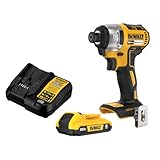
For a first cordless tool, choose a kit that includes at least one battery and a charger. A 2.0Ah battery keeps weight down for overhead work; a 4.0Ah pack provides more runtime but adds noticeable weight. If you already own batteries in a tool system, a bare tool is often the cheaper choice. Compare compact 18V or 20V impact-driver kits by speed settings, included battery capacity, weight, and warranty—not just advertised torque.
Bits and fasteners make a difference
Use the bit specified for the screw head, and keep a spare nearby. A worn or poorly matched bit cams out, chews up the recess, and can leave a screw proud. For common construction screws, a fresh impact-rated Phillips, square, or Torx bit matched to the fastener is more useful than a large assortment of generic bits. Check that the screw manufacturer allows impact-driver use. Browse impact-rated driver bits in the required head style.
Do not choose a screw solely by length. The fastener must provide the required penetration into the supporting framing after passing through the sheathing, while meeting the project’s specifications. Overlong screws can hit wiring or other concealed materials in some assemblies; undersized or nonstructural screws may not provide the required holding strength. When the plans call for nails, use the specified nails and spacing instead of improvising with screws.
Drive screws without damaging panels
Set the panel firmly against the framing and start each screw square to the surface. Begin at a low speed, then increase pressure once the threads have engaged. Stop when the head is seated as specified—typically flush with the panel surface, not buried in it. A crushed OSB or plywood face can weaken the local connection, and a countersunk screw is difficult to correct without replacing or supplementing the fastener according to the plans.
Test the tool and screw combination on a scrap piece of the same sheathing over a framing offcut. If the driver repeatedly sinks heads too far, use a lower speed, lighter trigger pressure, or a driver with a fastening mode. Some impact drivers have no true depth stop, so the operator must release the trigger at the right moment. A drill/driver with an adjustable clutch can offer more consistent depth control for smaller screws, though it may be slower on long fasteners.
Keep the driver aligned and press firmly enough to prevent the bit from bouncing out. If a screw stalls, do not keep hammering the trigger: back it out, inspect the bit and screw, and check for a knot, framing misalignment, or a damaged pilot hole. Pre-drilling may help near panel edges or where splitting is a concern, but follow the fastening instructions rather than assuming a pilot hole is always needed.
When to spend more—and when not to
A premium driver is worthwhile if you regularly fasten structural screws, need a durable tool for daily work, or value multiple control modes and a lighter compact body. For a single roof repair or a modest shed, a basic 18V/20V driver with a variable-speed trigger is usually enough. Renting or borrowing can beat buying if this is a one-time task, especially if the required fasteners are better driven with a different tool.
Do not work from an unstable ladder or handle a driver near an unprotected roof edge. Secure the work area, use appropriate fall protection, and keep loose batteries and screws from sliding off the roof. A well-controlled midrange driver, correct fasteners, and careful technique are a better combination than extra torque alone.