Key takeaways
- How to choose an 18V cordless drill that suits woodworking rather than framing, from a driller who cares more about clutch control than headline torque numbers.
What's inside
- What actually separates a woodworking drill from a framing drill
- Brushless, two speed, and why the low gear is the whole point
- Chucks, runout, and the small bits that expose a cheap drill
- The best 18v cordless drill for woodworking depends on your battery platform
- Do you also need an impact driver, and what about a drill press
- Technique that makes any decent drill perform better
- Frequently asked questions
- Related Guides
- What actually separates a woodworking drill from a framing drill
- Brushless, two speed, and why the low gear is the whole point
- Chucks, runout, and the small bits that expose a cheap drill
- The best 18v cordless drill for woodworking depends on your battery platform
- Do you also need an impact driver, and what about a drill press
- Technique that makes any decent drill perform better
- Frequently asked questions
- Related Guides
As an Amazon Associate I earn from qualifying purchases. This post may contain affiliate links at no extra cost to you.
Most guides to the best 18v cordless drill for woodworking get hung up on peak torque figures, which is the least useful number on the box if you build furniture, cabinets, or shop fixtures. I have spent most of my working life with a trigger under my finger, and the drills that made my life easiest at the bench were never the ones that could auger a 4-inch hole through a joist. They were the ones that stopped when I told them to.
Woodworking punishes a drill in a different way than construction does. You are drilling small pilot holes in expensive stock, driving screws into hardwood that will split if you look at it wrong, running a Forstner bit that wants to walk, and setting brass screws that strip if the clutch is even slightly generous. What you want is low-speed control, a clutch you can trust, a chuck that grips a 1/16-inch bit without slipping, and a trigger with a usable creep zone. Raw grunt is a distant fifth.
As an Amazon Associate we earn from qualifying purchases at no extra cost to you. Product prices and availability are accurate as of the date shown and are subject to change.




What actually separates a woodworking drill from a framing drill
Here is the short version of what I look at when someone hands me a drill and asks whether it belongs in a wood shop.
| Spec | Why woodworkers care | What to look for |
|---|---|---|
| Low-speed range | Controls pilot holes, Forstner bits, screw setting | A low gear that tops out roughly in the 400-600 RPM neighborhood |
| Clutch settings | Stops the screw before it strips or snaps | More positions and clear detents, not just 1-15 mush |
| Chuck | Small bits slipping ruins stock and bits | All-metal 1/2 inch ratcheting chuck, single sleeve |
| Weight and nose length | Working inside carcases and cabinets | Compact brushless head, under about 3 lbs bare |
| Brake | Screw depth repeatability | Fast electronic brake, not a lazy coast-down |
| Battery options | Bench work drains less than framing | A slim 2.0Ah pack plus one bigger pack |
Notice what is missing from that table. Hammer function does not matter for woodworking, and neither does the biggest torque figure on the spec sheet. If you never drill masonry, a plain drill/driver is lighter, shorter, and quieter than the hammer drill sitting next to it in the same lineup, and it usually costs less. Buy the hammer drill only if you also hang things on brick.
Brushless, two speed, and why the low gear is the whole point
Every 18V or 20V MAX platform worth buying now has a brushless drill/driver in it. DeWalt XR, Milwaukee M18 FUEL, Makita LXT, Bosch 18V, Ridgid Octane, Metabo HPT, and the rest all give you a compact brushless unit with two mechanical speed ranges. Brushless matters less for the power than for the electronic control: the tool can hold a slow speed under load instead of bogging and then lurching.
The mechanical two-speed gearbox is the feature I would refuse to give up. In low gear you get torque multiplication and, more importantly, a wide usable trigger range down at very low RPM. That is where you drill a 3/8-inch Forstner in maple without burning it, where you drive a 3-inch screw into white oak without cooking your wrist, and where you feel the moment a brass screw seats. In high gear the same drill turns twist bits and countersinks fast enough that you never think about it.
If a drill only has one speed range, it is a homeowner tool. It will drive deck screws fine and it will frustrate you every single time you touch furniture stock.
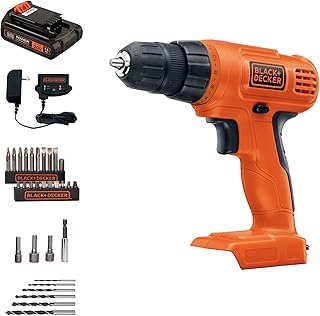
Compact brushless 18V drill/driver kits
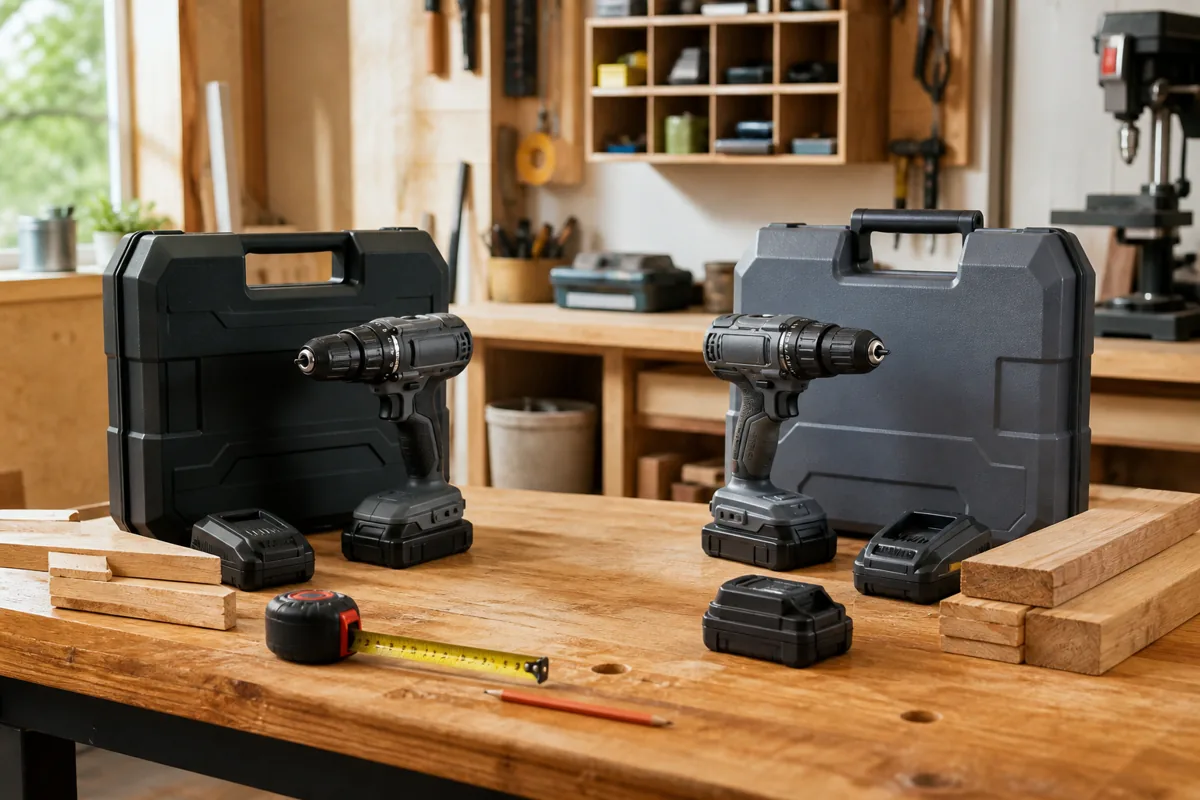
This is the category to buy first if you are starting from scratch. A compact brushless drill/driver with two speed ranges, an all-metal ratcheting chuck, and a 2.0Ah pack covers about 90 percent of woodworking drilling and driving, and it fits inside a cabinet carcase where a full-size hammer drill will not. Pick whichever major brand you already own batteries in, because the platform matters more than the individual tool.
Chucks, runout, and the small bits that expose a cheap drill
Woodworking is where chuck quality stops being an abstraction. Chuck a 1/16-inch brad point bit, spin it up, and watch the tip. On a decent all-metal 1/2-inch chuck it will look like a single line. On a worn or cheap chuck you will see a cone, and that cone is oversized pilot holes and snapped bits.
Three things I check. First, whether the chuck is all metal with a ratcheting or auto-tightening sleeve, because plastic-bodied chucks lose their grip on small shanks over time. Second, whether it is a single-sleeve design you can tighten one-handed while your other hand holds the workpiece. Third, whether the jaws actually close down to near zero, since some 1/2-inch chucks bottom out around 1/16 inch and will not hold anything smaller.
Practical technique note: on small bits, tighten the chuck in two or three passes and rotate the bit slightly between them. Ratcheting chucks grip better if you give the jaws a second bite. And when a bit does slip and scar its shank, retire it from the pilot-hole rotation. A galled shank never grips right again.
The best 18v cordless drill for woodworking depends on your battery platform
I am going to be blunt about this, because it saves people real money. The differences between the top-tier compact brushless drills from the major brands are small enough that you will not notice them across a weekend of cabinet work. The differences between battery platforms are permanent. Chargers, packs, and the twenty other tools you will eventually want all live on that platform.
So the honest answer is: buy the best compact brushless drill/driver on the platform you already own, or the platform whose broader lineup you actually want. If you have no tools at all, the biggest lineups give you the most room to grow, and the mid-tier lines give you a cheaper entry with fewer specialty tools later.
- ✔ Two-speed brushless gearbox gives real low-RPM control
- ✔ All-metal ratcheting chuck holds small brad point bits without walking
- ✔ Compact head reaches inside cabinets and between rails
- ✔ Clutch plus a fast brake makes screw depth repeatable
- ✔ Batteries carry over to sanders, routers, vacuums, and lights
- ✘ Top-tier kits cost noticeably more than budget single-speed drills
- ✘ Big 5.0Ah packs make a bench drill nose-heavy and awkward
- ✘ A drill clutch is still less precise than a dedicated impact driver for long screws
- ✘ Hammer drill versions add length and weight you will never use in wood
Do you also need an impact driver, and what about a drill press
Yes, eventually, and they solve different problems. The drill is for holes and for controlled, clutch-limited driving where you care about the final depth. The impact driver is for long fasteners, ledger screws, structural screws, and lag bolts, where the hammering action does the work your wrist would otherwise absorb. Two-tool combo kits usually cost only a little more than the drill alone, which makes them the sensible entry point.
Where I would push back on a common assumption: an impact driver is the wrong tool for small brass or steel screws in fine work. It will twist the head off before you register what happened. Keep those on the drill with the clutch set low.
A drill press is a separate purchase and it does not replace the cordless drill. It replaces the cordless drill for repeatable perpendicular holes in stock you can carry to the machine. Everything on the assembly bench, in the carcase, and on the job stays cordless.
18V drill and impact driver combo kits
If you are buying into a platform for the first time, the two-tool combo is almost always the better deal per tool. You get the drill for holes and clutch-controlled driving, plus the impact for structural fasteners, and typically two batteries and a charger. Check that the kit includes the brushless versions of both tools rather than the older brushed models, which still show up in discounted kits.
Technique that makes any decent drill perform better
Bit choice does more for hole quality than tool choice. Brad point bits for clean entry in face grain, Forstner bits for flat-bottomed holes and overlapping cuts, and twist bits for metal and rough work. Auger bits belong in framing, not furniture.
Run large-diameter bits slowly. A 1-inch Forstner in hard maple wants low gear and light, steady pressure, and it wants you to back out and clear chips. Burnished, blue-black hole walls mean you were too fast, pushing too hard, or both. Small twist bits are the opposite: they want speed and very little pressure.
Pilot holes are not optional in hardwood. Size the pilot to the screw’s shank, not the thread, and countersink separately rather than letting the screw head crush the fibers. On end grain and near edges, go slightly larger. And set your clutch by testing on offcut stock from the same board before you touch the real joint. That habit has saved me more expensive lumber than any tool feature.
Frequently asked questions
Is 18V enough for woodworking, or should I go 12V or higher? 18V (marketed as 20V MAX by some brands) is the sweet spot. A modern 12V brushless drill is genuinely capable for cabinet work and lighter to hold overhead, but it runs out of headroom on large Forstner bits and long screws in hardwood. Anything above 18V is aimed at concrete and heavy construction.
Do I need a hammer drill for woodworking? No. Hammer mode does nothing in wood, and the mechanism adds length, weight, and cost. Buy the plain drill/driver unless you also drill masonry, in which case one hammer drill covers both jobs adequately.
What battery size should I use at the bench? A slim 2.0Ah pack for most work, since it keeps the drill balanced and lets it stand up on the bench, plus one larger 4.0Ah or 5.0Ah pack for long assembly sessions or big bits. Compact packs generally deliver enough current for drill duty; you notice the difference mostly in runtime.
Pick the platform, buy the compact brushless drill/driver on it, spend the leftover money on good brad point and Forstner bits, and learn where the clutch clicks. That combination will out-drill a more expensive tool used carelessly.
Check prices on Amazon →