Key takeaways
- Miller's practical guide to the best compact cordless drill for home use, covering head length, 12V versus 18V, chuck choice, and the speed and pressure habits that make clean holes.
What's inside
As an Amazon Associate I earn from qualifying purchases. This post may contain affiliate links at no extra cost to you.
Most people buy far more drill than their house needs. I have watched a homeowner wrestle a full-size hammer drill with a 5.0Ah pack on it to set two drywall anchors for a curtain rod, then shove the case back in the closet for a year. The best compact cordless drill for home use is not the one with the biggest torque number on the box. It is the one light enough that you grab it without thinking, and stout enough that it does not sag when the bit finds a stud.
I drill holes for a living, and the tool that rides in my truck cab instead of the gang box is always a compact: short head, slim battery, no side handle. Here is how I sort them out, plus the technique that matters more than any spec sheet.
As an Amazon Associate we earn from qualifying purchases at no extra cost to you. Product prices and availability are accurate as of the date shown and are subject to change.



| Class | Best for | What you give up |
|---|---|---|
| 12V subcompact brushless | Cabinets, furniture, overhead work | Big hole saws in hardwood |
| 18V/20V compact brushless | All-around homeowner work, decks, repairs | Half a pound of weight |
| Brushed 18V/20V compact | Light duty on a budget | Runtime and low-speed control |
| Compact hammer drill | Anchors in brick and block | Head length and noise |
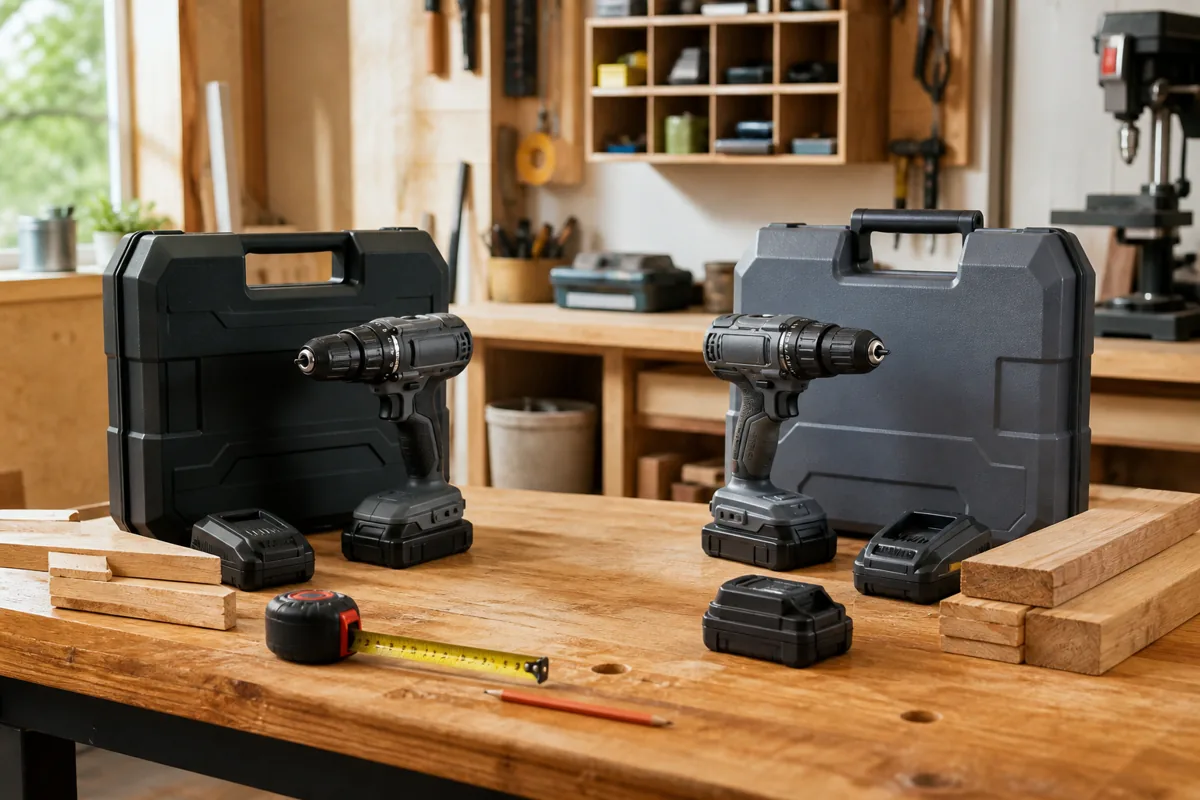
What Makes The Best Compact Cordless Drill For Home Use
Head length first. Measured from the back of the motor to the chuck tip, this is the whole reason compacts exist. Six to seven inches fits between studs and inside a sink cabinet. A full-size drill runs eight or nine, and you feel every one of them working on your back under a vanity.
Then weight with the battery in it. Bare tool weight is a marketing figure. What counts is what your wrist holds while you pilot a hole in a ceiling joist, and a compact with a slim pack usually lands between two and three and a half pounds.
Then a two-speed gearbox. Low gear is torque and control for driving and for big bits; high gear is the RPM that twist bits and brad points need to cut clean instead of burnish. Single-speed drills exist at the bottom of the market and you will resent one inside a week.
Then brushless, if the budget stretches. It runs cooler and draws less current for the same work, which on a small battery turns into real runtime. On chucks: 1/2-inch ratcheting metal jaws grip round shanks better and take bigger bits, while a 3/8-inch chuck is shorter and lighter. Running hole saws? Take the 1/2-inch.
12V Brushless Compact Drill/Driver Kit
If your projects live inside cabinets, furniture and junction boxes, this is the class you will actually reach for. Short head, real clutch, two slim packs. It will not enjoy 2-inch hole saws, and that is the honest trade.
12V Or 18V: Where The Difference Shows Up
Both classes drive screws. No 12V subcompact embarrasses itself setting cabinet hinges or assembling a bench with structural screws in softwood. The gap opens when you start removing a lot of material at once.
A 12V handles twist bits to about 3/8 inch, spade bits to an inch in pine if you peck, and self-drilling screws all day. Put a 2-1/8 inch lockset saw in one and push it through a solid-core door and it will heat up, lose speed and drain the pack. An 18V or 20V compact makes that cut on a 2.0Ah battery if you keep the sawdust clear.
So: furniture, cabinets and blinds, buy the 12V and enjoy your wrist. A house with a deck, a fence and a garage full of framing lumber, buy the 18V or 20V compact and run a slim pack on it.
Compact Brushless Drill and Impact Driver Combo Kit
For most homeowners this is the right buy. The drill makes holes and does the clutch work; the impact driver sinks long screws and lags without twisting your wrist. Two batteries and a charger usually come along, which is where the money goes anyway.
Speed, Pressure And Pilot Holes
A cheap drill in trained hands beats a good one used badly. The short course:
Match speed to material
Wood likes speed: high gear, steady feed, sharp brad points. Steel likes the opposite: low gear, firm continuous pressure, a drop of cutting oil. Watch what leaves the hole. Chip curls mean you have it right. Fine dust and a blue bit tip mean you are cooking the cutting edge.
Pressure feeds the bit, it does not force it
Leaning on a drill is how people snap 1/8 inch bits. Push just hard enough to keep the bit taking material. If it quits cutting, the bit is dull or you are in the wrong gear, and more shoulder fixes neither. With spade bits and augers, back out every half inch to clear the flutes; packed chips stall compact drills far more often than low torque does.
Size pilot holes the easy way
Hold the bit up in front of the screw. It should cover the solid shank with the threads still showing on both sides. Too small and you split the board or twist the head off, too big and the threads have nothing to bite. Pilot everything in hardwood, and anything near an end or edge in framing lumber, then countersink so the head seats instead of crushing fibers.
Clean starts and clean exits
On steel, mark with a center punch first or the bit walks and you end up filing an oval. To avoid blowing out the back of a board, clamp a scrap behind it and drill into the scrap, or ease off in the last eighth of an inch and let the bit whisper through. In drywall, stop the moment you are past the paper; wires and copper live back there.
- ✔ Short head reaches inside cabinets and between studs
- ✔ Light enough for overhead pilot holes
- ✔ Slim packs keep the tool balanced
- ✔ Clutch and two speeds cover household driving
- ✘ Bogs down on big hole saws in hardwood
- ✘ Small packs mean more charger trips
- ✘ No side handle, so a bound bit twists your wrist
- ✘ Not the tool for concrete floors
Batteries, Bits And What To Skip
Buy two batteries, keep both charged, and buy the small ones. A fat pack does not spin the bit any faster, it just makes a nimble tool nose-heavy. Pick one platform and stay on it, because chargers and packs are where the money really goes over ten years. DeWalt XR, Milwaukee FUEL, Makita LXT, Bosch and Ryobi ONE+ all sell compacts worth owning.
Skip mystery-seller aftermarket batteries and hundred-piece kits that are ninety screwdriver bits. Spend instead on a real index of twist bits, brad points for wood, a countersink, and a magnetic bit holder that does not drop tips. That is where hole quality comes from.
FAQ: Compact Drills Around The House
Do I need a hammer drill? Only for brick, block, mortar or concrete. Drywall, wood and plaster over lath do not need hammer action, and a plain drill/driver is shorter and lighter. If you do have masonry, a compact hammer drill on your existing battery beats a rotary hammer you will use twice.
How much torque do I actually need? Every brand measures torque its own way, so treat the figure as a rough class marker, not a comparison. A modern 12V brushless drill has plenty for household work and an 18V compact has more than enough. When a hole stops going, it is nearly always a dull bit, packed chips or the wrong gear.
Can one drill replace a drill and an impact driver? It can, but you will swap bits constantly and strip more heads. Drive more than a handful of long fasteners a year and the two-tool kit pays for itself in aggravation avoided.
Hand a new homeowner a compact brushless drill, two slim batteries, a sharp set of brad points and twist bits, and five minutes of the talk above, and they can handle most of what a house asks for. That is the point of a compact: it stays out where you will use it.
Check prices on Amazon →