Key takeaways
- How to pick the best brushless drill for the money, from a driller who cares more about clutch feel and chuck runout than headline torque numbers.
What's inside
As an Amazon Associate I earn from qualifying purchases. This post may contain affiliate links at no extra cost to you.
Most people shopping for the best brushless drill for the money end up staring at torque numbers, and that is exactly the wrong place to look. I have spent a long career making holes for a living, and I can tell you the drill that feels best in the hand is rarely the one with the biggest number on the box. Inch-pounds are measured at stall, at maximum battery voltage, in a lab. You will never work there. What you will notice, every single day, is whether the chuck holds a bit straight, whether the clutch releases before it snaps a screw head off, and whether the trigger gives you the bottom five percent of the speed range so you can start a hole without walking the bit across your workpiece.
Brushless is worth paying for, though not for the reasons the marketing implies. The real gain is that a brushless motor bogs down less under load, so when you lean into a 1-inch auger in a stud, the drill keeps pulling instead of screaming and heating up. You get more work per charge, cooler running, and a motor that will outlive the batteries. That said, a mid-tier brushless drill from a major line is usually plenty, and the money you save is better spent on decent bits and a second battery.
As an Amazon Associate we earn from qualifying purchases at no extra cost to you. Product prices and availability are accurate as of the date shown and are subject to change.




What the best brushless drill for the money actually needs
Here is the shortlist I would hand to a friend, in priority order, along with roughly what each tier of drill delivers.
| Feature | Why it matters | What to expect at the value tier | |
|---|---|---|---|
| Two-speed gearbox | Low range for augers and hole saws, high range for twist bits | Standard on nearly every brushless drill worth buying | |
| All-metal 1/2-inch chuck | Holds round-shank bits without slipping or wobbling | Common, but check for a metal collar rather than plastic | |
| Clutch settings | Stops you snapping screws and stripping softwood | 15 or more positions is plenty for most work | |
| Electronic brake | Bit stops the moment you release the trigger | Almost universal now, and genuinely useful | |
| Belt hook and LED | Small things you use a hundred times a day | Usually included | some budget kits drop the hook |
| Battery platform depth | Determines what else you can buy later | The real deciding factor, more than the drill itself |
Notice what is not on that list. Hammer function on a general-purpose drill is a nice-to-have unless you regularly drill masonry, and even then a rotary hammer does the job better with less abuse to your wrist. Brushless drill/drivers with hammer modes are fine, but do not pay a premium for a feature you will use twice a year on a couple of tapcons.
The platform decision comes before the drill
This is the part people get backwards. You are not buying a drill, you are joining a battery system, and you will be in it for a decade. DeWalt’s 20V MAX XR line, Milwaukee’s M18 FUEL family, Makita’s 18V LXT range, Bosch’s 18V lineup, and Ryobi’s ONE+ HP brushless tools all make a perfectly good drill. Where they differ is what comes next: how many tools share that battery, what the batteries cost when one dies, and whether your local retailer stocks them.
If you already own batteries from any of those brands, buy the bare tool in that system and stop reading comparison charts. The performance gap between a good mid-tier brushless drill and a flagship is smaller than the gap between owning two batteries and owning one.
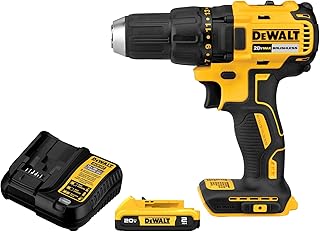
Brushless drill and impact driver combo kit
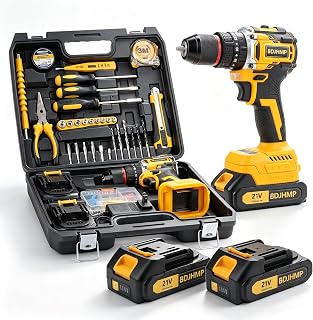
A two-tool kit with two batteries and a charger is almost always the smartest buy, and it usually costs barely more than the drill alone. You want the impact driver anyway: it drives long fasteners far better than a drill and saves your drill’s clutch and your wrist. Look for kits with compact batteries in the 2.0Ah range for daily work plus at least one larger pack for augers and hole saws.
Compact versus full-size, and why I own both
A compact brushless drill is typically around 7 inches front to back and light enough to hold overhead without your shoulder filing a complaint. A full-size unit is longer, heavier, and pulls harder in low gear. If you are doing cabinet installs, electrical rough-in between studs, or anything in a crawlspace, the compact wins on access alone. If you are boring through joists or mixing thinset, you want the bigger frame and a side handle.
For most buyers looking for value, the compact brushless drill is the right first purchase. It handles 90 percent of drilling and driving, and when you hit the other 10 percent you will know it and can add a right-angle drill or a proper hole-hog later.
- ✔ Brushless motors keep RPM under load, so you finish holes instead of stalling
- ✔ Longer runtime per charge, which matters more than peak torque
- ✔ Less heat and no brushes to replace, so the tool outlasts several battery cycles
- ✔ Mid-tier brushless models are close enough to flagships for most work
- ✘ You pay a premium over brushed models that may not pay off for light occasional use
- ✘ Headline torque figures are marketing, not a usable spec
- ✘ Bare tools lock you into one battery platform for years
- ✘ Cheap chucks and weak clutches show up even on brushless drills
Technique: get the drill to do the work
A good drill will not save bad habits, so here is how I actually run one. For twist bits in wood and metal, high gear, and let the bit cut rather than pushing it. Steel wants slow speed and steady pressure with a little cutting oil, and if you see blue chips you are running too fast and cooking the edge. In hardwood over about 1/2 inch, switch to low gear and back the bit out every inch to clear chips, or the flutes pack and the bit binds.
Always mark and dimple. A center punch in metal or an awl in wood gives the bit a place to start, and it eliminates the walk that ruins a layout line. For anything over about 3/8 inch in hardwood, drill a pilot roughly the diameter of the screw shank so the threads have something to bite without splitting the stock. When you are driving into a hardwood face frame, run a pilot plus a countersink and set the clutch two or three clicks below where it starts to cam out, then test on a scrap of the same species.
One more thing about clutches: they wear. If your drill starts snapping screws that it used to seat cleanly, the clutch pack is glazing over, not the screws getting weaker. That is when you switch the driving work to an impact driver and let the drill go back to drilling.
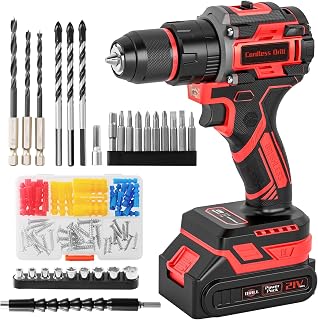
Impact-rated bit and driver set
Bits are where cheap kits fall apart. A brushless drill with soft, off-brand twist bits will drill worse than a ten-year-old brushed drill with quality bits. Get a set with hardened impact-rated driver bits, a range of twist bits in 1/16-inch steps, and a couple of brad-point bits for clean wood holes. Replace individual sizes as they dull rather than buying another whole case.
Where the money is well spent, and where it is wasted
Spend on batteries. Two mid-capacity packs beat one big one, because charging time is your real bottleneck on a job. Spend on bits and hole saws, which do the actual cutting. Spend on a proper side handle if you plan to run anything over 1 inch, because a drill that grabs will twist your wrist hard enough to remind you for a week.
Save on the flagship badge. Save on the hammer function unless masonry is routine work for you. Save on the 12-piece accessory bundle full of bits you will never touch, and save on the fabric bag if a hard case version costs the same.
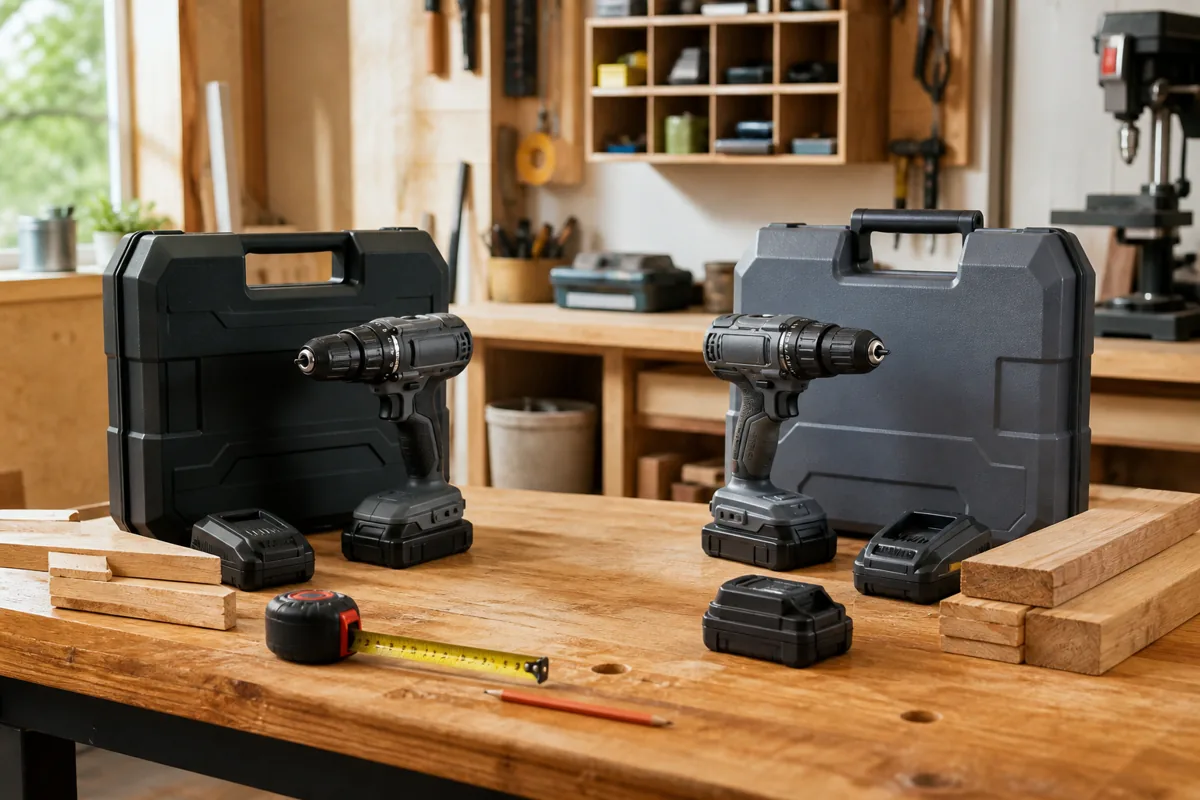
Compact brushless drill, bare tool
If you already have packs from a major platform, buying bare is the cheapest route to real brushless performance. Confirm the tool matches your battery generation, check that the chuck is metal rather than plastic-bodied, and look for two-speed gearing. A bare compact brushless drill plus batteries you already own is hard to beat on value.
FAQ
Is a brushless drill really worth the extra cost? For regular use, yes. The motor holds speed under load, runs cooler, and stretches a charge noticeably further, which you feel most when boring larger holes. If you use a drill a handful of times a year to hang blinds, a brushed model with a good chuck will serve you fine and the savings go into bits.
Do I need a hammer drill, or is a drill/driver enough? A drill/driver covers wood, metal, plastic, and driving. Hammer mode helps for occasional anchors in block or brick, but for repeated concrete work an SDS rotary hammer is faster, cleaner, and far easier on your arms. Do not let hammer function be the reason you pay more.
What battery size should I buy with a brushless drill? Two packs beat one, and mid-capacity is the sweet spot. Something in the 2.0Ah range keeps the drill balanced and light for overhead work, and a 4.0Ah or 5.0Ah pack covers augers, hole saws, and long driving sessions. Keep one on the charger and rotate.
My take
The value winner is almost never the drill with the biggest torque claim. It is a two-speed brushless compact from a platform your other tools live on, bought as a combo kit with an impact driver and two batteries, paired with bits that are actually sharp. Get that combination right and the drill disappears into the work, which is the highest compliment I can pay a tool.
Check prices on Amazon →