What's inside
As an Amazon Associate I earn from qualifying purchases. This post may contain affiliate links at no extra cost to you.
Repeated anchor installation is harder on a drill than an occasional hole for a picture hook. A long run of holes in concrete or masonry can heat the bit, drain a small battery quickly and expose the limits of a compact hammer drill. The right brushless model depends on the hole diameter, material and pace of work—not just the largest torque number on the box.
As an Amazon Associate we earn from qualifying purchases at no extra cost to you.



What we cover
Choose the right tool for the material
For common plastic plugs and light-duty masonry anchors, a brushless cordless hammer drill is often the practical choice. Its rotating chuck accepts standard round- or hex-shank bits, and its hammer mode adds fast, short impacts while the bit turns. It can also drill wood and metal with hammer mode off.
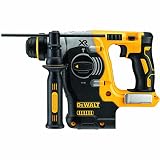
For many holes in hard concrete, especially with bits larger than about 3/8 inch, a rotary hammer is usually faster and less tiring. Rotary hammers use an SDS bit and a stronger impact mechanism. They are less versatile for ordinary drilling, but the difference matters when a job involves dozens of deep holes. If that describes your work, compare cordless SDS rotary hammers before buying another standard hammer drill.
What to look for in a brushless hammer drill
Brushless motors reduce internal wear and generally use battery power efficiently, but they do not guarantee that a drill can sustain a long run of masonry holes. Look for a two-speed gearbox, a side handle, a clutch, and a hammer mode that can be switched off. The side handle is a safety feature as well as a comfort feature: a bit can bind suddenly in aggregate and twist the drill hard enough to injure a wrist.
Battery capacity affects how long you can work between swaps. A 2.0 Ah pack is lighter, but a 4.0 or 5.0 Ah pack is more useful for repeated drilling. A larger pack adds weight, so consider whether you will be holding the drill overhead or working at arm’s length. For a new system, a brushless hammer drill kit with a 4.0 Ah battery is a sensible starting point for moderate anchor work.
Check the maker’s stated maximum masonry bit diameter, but treat it as a limit, not a promise of fast production. Drilling a few 1/4-inch holes is different from repeatedly boring 1/2-inch holes in reinforced concrete. For the latter, a rotary hammer or a corded tool can be a better purchase.
Compare the main options
| Tool type | Best fit | Main trade-off |
|---|---|---|
| Compact brushless hammer drill | Small anchors, occasional work, tight spaces | Less sustained power and battery life |
| Full-size brushless hammer drill | Repeated small and medium holes in masonry | Heavier; still slower than an SDS tool in hard concrete |
| Cordless SDS rotary hammer | Many larger or deeper concrete holes | More specialized, heavier, and requires SDS bits |
| Corded hammer drill | Long sessions near an outlet | Cord management and less convenient access |
A full-size drill is a good middle ground when you need one tool for wood, metal and masonry. A compact drill is fine for a small number of shallow holes; it becomes a poor bargain if it turns a short installation into a battery-swapping, overheating session.
Bits and technique make a measurable difference
Use a sharp carbide-tipped masonry bit sized for the anchor manufacturer’s hole specification. A bit that is too small can make an anchor difficult to insert; one that is too large can leave a loose anchor that spins or pulls out. Check the required hole diameter and minimum depth on the anchor packaging rather than guessing. For a typical plug, the hole must be at least as deep as the plug, with a little extra room for dust.
Keep the drill square to the surface and let the hammer action work. Pushing too hard can slow the bit, overheat it and enlarge the hole. Withdraw the bit occasionally to clear dust, especially in deeper holes. Dust packed at the bottom can stop the anchor from seating fully. If the bit stops advancing or the drill becomes unusually hot, pause and let it cool rather than forcing it.
Before drilling, confirm that the wall is actually masonry and check for wiring or plumbing. Avoid hammer mode on tile until the bit has passed through the tile; impact can crack the surface. When installing anchors in hollow block, follow the anchor instructions carefully: a standard expansion plug may not grip reliably in a thin or hollow section.
A practical buying decision
For fewer than a dozen small holes in brick or softer block, a basic cordless hammer drill and a fresh bit may be enough. If you already own batteries in a tool platform, buying the bare tool often saves money. Spend more only when the work justifies the added capacity, weight or features.
For regular installation runs, choose a full-size brushless hammer drill with a side handle and at least one mid-capacity battery. Keep a spare pack charging if downtime matters. If jobs routinely involve large holes or hard concrete, move up to an SDS rotary hammer instead of expecting a standard drill to behave like one. For replacement bits, choose a carbide masonry bit set rated for hammer drills, and replace worn bits before they turn every hole into a slow, hot one.