What's inside
As an Amazon Associate I earn from qualifying purchases. This post may contain affiliate links at no extra cost to you.
What we cover
What you need for small holes in natural stone
For a few small holes in granite, marble, slate, or a stone veneer, a cordless hammer drill can work—but the hammer setting is often the wrong place to start. Stone varies: a hard granite tile is a different job from a soft limestone wall, and a brittle tile can crack from impact even when the bit is sharp. For holes around 1/8 to 1/4 inch, use a sharp masonry bit and begin with rotation only. Add gentle hammer action only if the bit stops making progress and the stone is solid, not a thin tile or veneer.
If you are drilling polished or installed stone, patience matters more than maximum torque. A standard cordless drill with variable speed is often the safer choice for a handful of small holes. A hammer drill is useful when you also need to drill into concrete or brick, but it does not make a poor bit or excessive pressure safer.
As an Amazon Associate we earn from qualifying purchases at no extra cost to you.
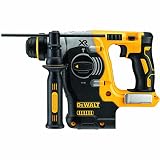


Which drill type makes sense?
| Tool | Best use | Trade-off |
|---|---|---|
| Variable-speed drill/driver | Small holes in tile, marble, or fragile stone; occasional DIY work | Slower in hard stone, but gives better control without impact |
| Cordless hammer drill | Mixed work in stone, brick, and concrete; frequent masonry drilling | Heavier and easier to misuse on brittle stone; switch hammer action off when starting |
| Rotary hammer | Larger or repeated holes in concrete and masonry | Usually excessive for small holes in finished natural stone |
For a general-purpose purchase, look for a cordless drill with a two-speed gearbox, a variable-speed trigger, and a clutch. A hammer drill with a clearly selectable drill-only mode is more versatile than a tool that is always in impact mode. Compare cordless hammer drills with a drill-only mode if you need one tool for both stone and ordinary masonry.
For one small project in a home with no concrete work planned, a basic drill/driver is usually enough. Paying extra for a hammer mechanism does not improve hole quality in delicate stone; control and the right bit do. If you already own a hammer drill, use its drill-only setting rather than buying another tool.
Choose the bit for the stone
Use a carbide-tipped masonry bit for many small holes in unglazed stone. For hard, dense stone and polished tile, a diamond-tipped bit is often the better choice because it cuts the surface rather than relying on blunt impact. A small diamond hole saw is also useful for larger openings, but it needs careful cooling and is not a substitute for a twist-style bit in every situation. Check the bit maker’s instructions: some diamond bits are designed for wet use, while others are rated for dry drilling.
Match the bit diameter to the anchor or fastener requirements, not just the screw diameter. A common small wall-plug hole may be about 1/4 inch, but follow the anchor packaging. Drilling a hole only slightly too large can make an anchor spin or pull out. If you are unsure, test on an offcut or an inconspicuous area before drilling a visible face.
For harder stone or repeated holes, compare diamond bits rated for natural stone. They cost more than basic masonry bits, but can reduce wandering and chipping when used at the recommended speed. Cheap carbide bits are reasonable for soft stone and a few hidden holes; they may dull quickly in granite.
How to drill without cracking or wandering
Mark the hole and cover the spot with masking tape if the surface is slick. The tape helps the bit stay put, though it will not prevent a crack. Keep the drill square to the surface, start at low speed, and let the bit cut. Do not lean hard on the drill: too much pressure can overheat the bit, chip the stone, or make the tool jump when the bit breaks through.
Use steady, light pressure and pause if the bit or stone gets hot. For bits that require water, keep the cutting area wet as directed and protect nearby electrical connections. Do not add water to a bit or tool unless its instructions allow wet drilling. Clear dust from the hole periodically, and stop before breaking through the back of a thin slab. If the stone is installed over a wall, switch to the correct bit for the backing material once you pass through it.
Keep hammer action off for polished stone, thin tile, slate, marble, and stone veneer. If you are drilling a thick, solid piece of hard stone with a masonry bit and rotation alone stalls, try the lightest available hammer setting at low speed. Stop if you see cracks, hear sharp changes in the stone, or feel the drill beginning to bounce. A crack can travel beyond the visible hole, especially near an edge.
Anchors, edges, and common failures
Stone itself may be strong, but a thin facing or weak mortar bed is not a reliable place to anchor a heavy load. Use a fastener suited to the stone and the substrate behind it, and size the hole exactly as specified. Do not assume a plastic wall plug will hold the same load in every kind of stone. For a heavy shelf, handrail, or overhead item, identify what is behind the stone and use an appropriate masonry fastening system.
Avoid drilling close to a free edge, corner, or existing crack. As a practical starting point, keep a small hole at least about 1 inch from an exposed edge when the layout allows; brittle or thin stone may need more clearance. Wear eye protection, and use hearing protection if drilling repeatedly. Stone dust can be hazardous, so control dust with a suitable vacuum or the wet method specified for the bit, and avoid breathing the dust.
The most common failures are a dull bit that polishes instead of cutting, hammer action that chips the face, excessive pressure that overheats the tip, and a hole drilled too large for the anchor. If progress stops, back out, clear dust, check the bit, and reduce pressure before changing tools. More force is rarely the fix.